Why We Need the Dark Parts: Fairy Tales, Sacred Law, and the Moral Imagination


We were sitting together at the table, my Bible open. Morning light was landing on crayons and construction paper. We all were a few years younger.

I turned to the day’s passage and found myself recounting the story of Uzzah.

You know the one. The Ark of the Covenant is being carried to Jerusalem. There is music and dancing and David himself is leaping before the Lord. Then… the oxen stumble. The Ark tilts. And a man named Uzzah, walking right beside it, reaches out instinctively to catch it.

He dies.

On the spot.

I heard a small gasp and looked up from the page. My oldest was staring at me.

“He died?!”

I nodded.

“But wasn’t he just trying to help?”

And just like that, we were in the middle of learning I had never planned that morning— the kind that no lesson plan could manufacture.

It’s the kind only a story can open.

Why Obedience Is Obedience

My daughter’s instinct was good and right and deeply human. Uzzah was trying to help. By every standard of normal human evaluation, his was a protective impulse. And yet…

As we talked through the story, three different ideas emerged that I still think about often.

The first is simply this: obedience is obedience. The instructions for transporting the Ark had been given clearly– designated priests, carried on poles, never touched by hand. The whole procession, as it turns out, had already been done incorrectly. They were using a cart instead of the shoulders of the priests, which was not what God prescribed. So, Uzzah’s death? It doesn’t come out of nowhere. Accumulated carelessness finally meets the consequences it had been ignoring. When we disobey, even for what feels like a good reason, even with genuinely protective motives… it is still disobedience. The consequence doesn’t negotiate with the intention.

My daughter asked, the way she does.

“But doesn’t why you do something matter?”

It does, I told her. Motive matters to God, and it matters morally. But it doesn’t cancel the consequence of the action itself. We do not get to decide which rules apply to us based on how good our reasons feel to us in the moment.

The conversation led to another question. I asked her: if Uzzah had touched the Ark and nothing happened… if God had simply let it go because Uzzah’s heart was in the right place, what would that tell us about God’s Word? Would it mean that God didn’t really mean what He said? What would that make God look like?

In a small voice, she gave the answer: “A liar.”

And God is not a liar.

God’s holiness is a bit easy to miss when we are busy feeling our feelings about Uzzah. But if God’s commands bend when the circumstances feel sympathetic enough, they are not commands at all. They are suggestions. And a God whose word dissolves under sufficient emotional pressure is not a God whose word can be trusted at all.

It was the third question that was maybe the most obvious, but also the most meaningful: Does God ever need man to save His holiness?

No. He does not.

The Ark did not need Uzzah’s hand. God’s purposes do not depend on man’s intervention, however well-meaning. The story of Uzzah, for all its seeming severity, shows us it is God’s holiness that saves us– not that our works can save Him.

We closed the Bible eventually and moved on to other things… probably math at some point. But that conversation stayed with me. And it has shaped the way I think about every hard, dark story we read, in Scripture and everywhere else.

The Stories That Do the Deepest Work

C.S. Lewis wrote that fairy tales don’t give children their first encounter with darkness and danger because children already know those things exist. What fairy tales give them is the right shape for those things. A form to pour experience into. A way of understanding the weight of things before life hands them the real version.

You can tell a child that pride leads to ruin and they will nod and move on. But give them the Evil Queen standing before her mirror— daily, obsessively, asking the same consuming question over and over— and something different happens. The child sees pride. They see envy. They see its posture, its ritual, its obsessiveness. They feel its grotesqueness before they have a word for it. The story does moral work that a lesson never could.

This is exactly what happened at our school table that morning. I didn’t plan a lesson on the holiness of God or the nature of obedience. The story opened the door, and we walked through it together.

That is what living stories do. That is what Charlotte Mason understood when she insisted on putting real books— books with weight and consequence and beauty— in front of children rather than sanitized retellings and watered-down lessons. The imagination is the first moral faculty. It must be formed before the intellect can reason from it.

And the moral imagination is formed by story.

What Fairy Tales Actually Teach

Snow White is not a story about envy the way a lesson is about envy. It is envy, dramatized into a character who cannot stop feeding it.

The mirror is not set dressing. It is the theological center of the Queen’s arc. She has made comparison her god— her devoted daily ritual— and the story follows that worship to its only possible conclusion: destruction. That’s where idolatry always ends.

No narrator announces that pride is wrong. No moral is delivered at the end. The consequence is the commentary. The Queen is not destroyed by Snow White. She is destroyed by her own escalation, her own willingness to go further and further in pursuit of what can never satisfy. The child who hears this story does not just learn that pride and envy are wrong. The image and story of the Queen becomes part of the imagination— a moral reflex that abstract instruction doesn’t instill.

And then there is Snow White herself. She accepts the apple— a failure of discernment, maybe of character?— but the story does not punish her into oblivion. She is preserved. Seven unlikely creatures keep vigil over her in a glass coffin, for no reason except that goodness is worth guarding even when it cannot guard itself. No one has to explain why this is right and true. The child simply feels the tenderness and truth of it, and understands, somewhere below the level of words, that love is a form of faithfulness.

Two moral arcs, running at once. One showing where envy and pride end. One showing what goodness is worth. And neither one delivered as a proposition.

The Birds That Remember Everything

Let’s move away from Snow White and talk about Cinderella. This fairy tale has a layer most of us were never given when we were children— and its absence is exactly the problem this post is about. A significant part of the story was quietly removed from the version that became the standard because someone decided we couldn’t handle the real ending.

In the Brothers Grimm telling, the stepsisters don’t simply fail to fit the golden slipper (glass is the French version of Cinderella) and walk away embarrassed. Their mother coaches each of them to mutilate herself— one cuts off her toes, the other her heel— to force the slipper to fit. The same doves who helped Cinderella sort lentils from ashes throughout the story call out the blood pooling in the shoe each time the prince rides away with the wrong girl. And at the wedding, as the bridal party walks into the church, those birds peck out one eye from each stepsister… and on the way back out, the other. Both of them. Permanently. The story ends with two blind women instead of the ones who came hoping to share in the glory of the girl they tormented for years.

I know. I can hear you. That is a lot.

But stay with me, because this is exactly the logic of Uzzah. The consequence feels disproportionate to our modern sensibilities. It is meant to. The fairy tales calibrate something– the same thing Uzzah’s story calibrates: a sense that moral reality has weight, that cruelty accumulates, that the world does not simply reset when the victim rises.

Those birds are not incidental. They are moral agents in the story’s universe. They helped Cinderella because she was faithful. They exposed the fraud because the moral order demands truth. They completed the justice because the story insists— as Scripture insists— that sustained wickedness does not simply dissolve when it becomes inconvenient to acknowledge.

And notice: Cinderella herself does nothing. She is radiant at her wedding while justice completes itself around her. She did not scheme for it, did not ask for it, did not even watch for it. The moral order simply finished what it started. Goodness and grace are not passive — they participate in something that moves, quietly and comprehensively, toward its end.

What We Lose When We Soften Everything

When the birds become cheerful little songbirds who sew dresses and the story ends at the wedding with no reckoning for anyone, Cinderella becomes a story about a nice girl who got lucky.

That is arguably a worse moral lesson. It suggests that goodness leads to a pleasant life if you wait long enough while cruelty simply fades out of frame. It trains the imagination to expect a world that does not exist. So when life arrives with its actual weight— when cruelty does not fade, when goodness costs something, when consequence shows up uninvited— the child formed on nothing but softened stories has no imaginative framework for it.

The Grimm version insists that the world remembers. The birds remember every lentil Cinderella sorted, every cruelty she endured, every small faithfulness she maintained when no one was watching. Moral order is not theatrical. It is comprehensive.

This is what my daughter was grappling with at the school table that morning. The story of Uzzah was uncomfortable precisely because it refused to let a good intention undo a real consequence. That discomfort was the lesson. That friction wasn’t something to smooth over. It was something to sit in, turn over, and eventually receive.

Give Them the Real Stories

Charlotte Mason believed that the atmosphere of a home, the books placed in children’s hands, the stories read aloud around a table are not supplementary to education. They are education in the deepest sense. They are the formation of the person who will one day reason, choose, love, and act.

A child who has been given the real stories— with their sacred gravity, their swift consequences— carries a framework into life that will serve them in ways they cannot yet articulate. They will recognize the Queen at the mirror when they meet her in themselves. They will understand, instinctively, why some things must not be handled carelessly. They will sense, when they encounter grace, that it is not random. It is intentional.

Fairy tales do not work simply because they are old, or unedited, or appropriately dark. They work because they are structurally aligned with how the Gospel actually operates.

Innocent suffering. Faithfulness in hiddenness. A moral order that cannot be cheated or charmed. Justice that is real and complete. Restoration that comes from outside the protagonist’s own effort.

That is the Gospel’s shape. Children formed on stories with that shape carry an imagination already tuned to how that kind of universe works. They are already prepared to recognize The Story when they meet it in full.

Let’s be clear about something though: not every story can do what fairy tales do. Modern stories and stripped down fairy tales run the opposite direction entirely. They muddy the moral imagination when they imply that following your heart and trusting your feelings is the right thing. They suggest that consequences do bend for good intentions. That villians are misunderstood, not evil. That happy ending belongs to whoever finally asserts themselves loudly enough.

That is not the Gospel’s shape. And a child formed on a steady diet of that moral universe will find the Gospel strange when they meet it— because everything about it runs counter to the world their imagination has been quietly inhabiting.

The old fairy tales, in all their severity and beauty, are preparing the ground. They are training the imagination to live in a world where holiness has weight, where faithfulness is noticed, where the moral order holds, and where grace comes to those who did not scheme for it.

Give your children those stories. Not because darkness is good for them…

but because the shape of those stories is true— and the imagination formed by truth is the one that will recognize the Truth when they see It.


If you are interested in digging deeper in these kind of thoughts, please look up The House of Humane Letters at https://houseofhumaneletters.com/. I explored these thoughts in my own grad classes, but I’ve loved revisiting and adding to those thoughts in the partial webinar that I’m listening to currently. Angelina Stafford also has a podcast called A Literary Life which you can learn more about here.

jam thumbprint cookies: a 5-ingredient (valentine) treat

My mother-in-law grows her own raspberry bushes. Rows and rows of them.

The kids love going to Wisconsin in the summer and just walking out there and stuffing their faces with these brilliantly red sweet snacks anytime they want.

The fruit is so abundant, Mom makes pies and cakes and jam galore… and then sends us back south, coolers packed with ice and her famous freezer jam. Throughout the year, we pull out a jar at a time for bread and sandwiches and even ice cream topping here and there. It’s divine.

The other day, I saw a picture of some beautiful raspberry thumbprint cookies, and knew that that our jam would have yet another application. I used this recipe as a base, but did make some tweaks, and will use them here. 🙂

We made a batch of these cookies for our poetry tea time, and the kids loved making them… and eating them. Because they were so very cute and festive, they will definitely be a part of our Valentine’s week coming up. ❤

raspberry jam thumbprint cookies

Ingredients
4 oz soften cream cheese
1/2 cup butter (room temp)
1/2 cup sugar + 2 Tbs
1/2 cup flour + 2 Tbs (all purpose)
jam (to fill the thumbprints)

Steps
1) Blend the cream cheese and butter together well. (As in fully incorporated.)
2) Mix in the sugar.
3) Mix in the flour, a “sprinkle” at a time. (The dough is going to be dense and not like “regular cookie dough.”
4) Wrap in plastic wrap and refrigerate for 30 minutes or longer. (We were impatient and waited 30 minutes.)
5) Put parchment paper or a silicon sheet on a baking sheet before making cookies. (We use something similar to these.)
6) Take tablespoons of dough and roll them into little balls before placing them on the sheet. The won’t really rise/spread, so you don’t have to worry about spacing much.
7) Once the cookie balls are placed on the sheet, press your thumb in them to make a “pool.” Don’t go all the way to the bottom. 🙂
8) Use a spoon to place some jam of choice into the divots in the cookies.
9) Preheat the oven to 350*. While the oven preheats, place the cookies in the fridge.
10) Once oven is preheated, take the cookies out of the fridge and into the oven, baking them for 10-12 minutes, until they are gold around the edges. When you take them out, they will still be soft, but they will harden as they cool.

They are simple, taste amazing, and look impressive. Create this colorful cookie (with or without the kiddos!) and enjoy.

a liturgy of preparation for a meal

I don’t know about you, but sometimes… I grow weary in well-doing. I’ve realized it isn’t actually the doing… it’s the reception of it. I feel like my work is worth something when it is received with gratitude and appreciation; but when my meals are met with whines or disenchantment, I mourn. And even get disgruntled deep down, because I feel like all of my good motivations and hard work— and good food— are just wasted.

Maybe that’s why this liturgy, found in Every Moment Holy, resonates so deeply. (The audio for this clip is not the whole thing, merely the beginning thoughts.) See, I need this prayer and reminder: that my meal planning and prep, my cooking and baking, my placing it on the table before my family is not just an act of service to them— but an act of worship to God.

And whereas one can argue that my children still need to work on thankfulness and the expression of it (they do 😂), I don’t need their approval of the main course or veggie side. It was and is worship— and God sees my work, even though He doesn’t need my meal to stave off His own hunger.

He takes and sees my offering.

And as the days pass, and I pray and cook, I have every hope that I am “an agent of a deep eternity, whose prepared meals might feed more than the body, nourishing also the hearts and hopes of those sometimes-weary souls who are well-served” by my labors.

Amen. 💛

easier than you think: soup from scratch

One of my goals this year in a part of living more simply is just to learn how to do the “convenience” foods easily with the foods that I already have on hand… instead of feeling like I need a bunch of ingredients to get dinner on the table.

A small way I’m doing that is by relying less on “staples” like canned soup, especially of the “creamed” variety.

If I have to be honest, we haven’t used a lot of a creamed of anything soups for a while, because of the additives and extras that I’m not a fan of. For instance, to make homemade cream of mushroom soup, you need 4 ingredients, up to six if you want actual cream in it and add salt.

Let’s look at the ingredients of what is in one of the most popular versions of mushroom soup. I copied and pasted directly from their website.

WATER, MUSHROOMS, VEGETABLE OIL (CORN, CANOLA AND/OR SOYBEAN), CREAM, MODIFIED CORNSTARCH, WHEAT FLOUR, SALT, MODIFIED MILK INGREDIENTS, SOY PROTEIN ISOLATE, MONOSODIUM GLUTAMATE, TOMATO PASTE, FLAVOUR, YEAST EXTRACT, DEHYDRATED GARLIC.

That’s a total of 14 ingredients, and that’s not counting any extra anything that sneaks in with vegetable oil, the modified milk ingredientS (plural means more than one, the last time I checked…), and also whatever is included in “flavour.”

(I’m not even going to go down the rabbit hole of what monosodium glutamate is… but it’s better known as MSG, if that helps get an idea. And some people really might be surprised to find soy in a cream of anything soup.)

So, what do you need to make your own creamed soup at home?

Easy: Butter. Flour.* Milk and/or cream. And then whatever other ingredient you want to be creamy. So, chicken for cream of chicken soup. Celery for cream of celery soup. Mushroom for mushroom.

(I’ll stop insulting your intelligence now. Ha!)

Oh, and salt and pepper, if you want to season the soup specifically vs. seasoning it with whatever you might be mixing it with.

Let’s chat steps. They are super easy.

First, melt your butter. For a medium thickness, you’ll start with 2 TBS.

If you are making a celery of mushroom soup, you’ll add it and soften it in the butter before adding salt and flour.

Once the butter is melted and your vegetables are softened…
Add the flour. For a medium thickness, you’ll add with 2 TBS.

Use a whisk to prevent lumps. Once it is incorporated…
Add 1 cup of liquid. Most of the time, it will be milk. In the case of cream of chicken, it should be half broth, half milk… and then add the cooked chicken.

Add salt as desired.

If you want the soup to be runnier or thicker, you’ll reduce or increase the amount of butter/flour at the beginning before adding the liquid. The flour and butter will be in equal amounts to each other.

How simple is that?

And can I say HOW MUCH BETTER it tastes? My 9 year old taste-tested and just asked me to make the soup for dinner all by itself.

Maybe next time, E… this batch is already claimed for a one-dish meal for dinner tonight. 😉

* For people who are gluten free, you can totally sub a gluten free flour here, but you might have to modify the amount of liquid, as gluten free flours with coconut flour are more absorbent. And I’ve even used almond flour itself as a replacement, but the texture is more “gritty” vs smooth, and obviously the fat is higher than the regular flour counterpart. It is definitely a viable substitute for those want to a much lower carb or flour-free version of the soup, though.

Random bits & pieces: free mulch and foraging

The weather is getting warmer, and the plants are making their way from the cups and little planters we started seeds in to our raised beds. Maybe I’m just getting old or maybe what excites me in my life has changed— probably both 😂— but gracious, I delight in seeing seedlings grow. Just little green bursts of friendly potential.

Watching my kiddos take pride in the plants is just another added privilege to see.

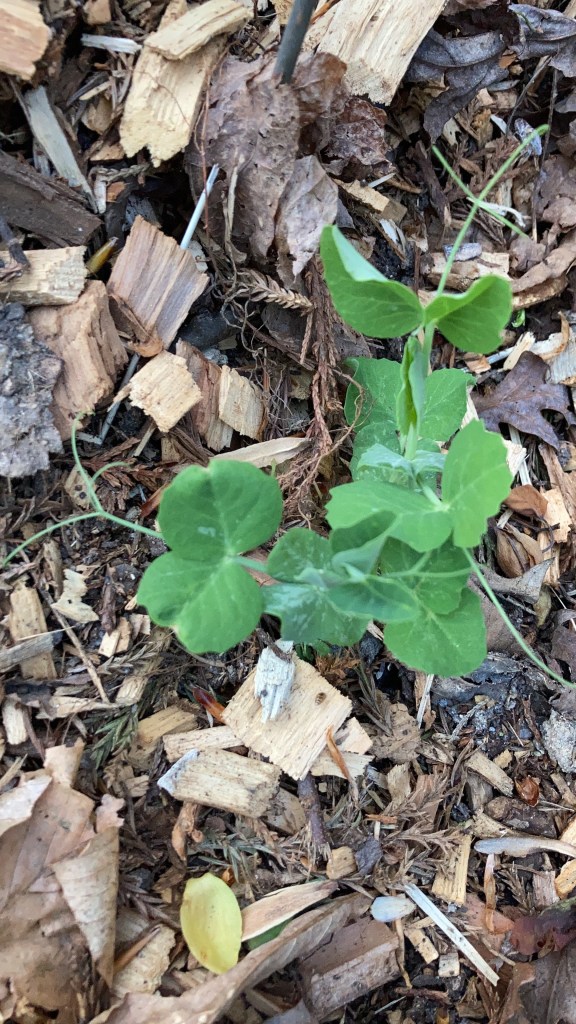
Behold, my buddy’s pea plant. 🙂

If you look at the picture above, you’ll see some mulch around the peas from a pile that we received for free from a company called Chip Drop (https://getchipdrop.com/). We went to the website, filled out our info and a few days later, a truck was dumping a huge mulch mountain in our front yard! We’ve placed it on our flower beds and in our raised beds as filler and enrichment.

It was completely free and convenient, and will be doing it again in the future, I’m sure.

Another way, besides gardening, that I’m enriching my own knowledge and experience is learning how to use “wild” and useful plants— for food, comfort, and wellness.

See, I didn’t grow up on a farm. I didn’t grow up learning about plants or animals, how to observe nature not just for its beauty, awe, and intricateness… but for how we can exist and be symbiotic with it— how it provides for us in unexpected places, and how we, in turn, can provide for it, too.

Here is a plant I never, ever knew was edible, and it grows in our shady spaces so incredibly well… hostas! Here was my first time, harvesting and cooking hosta from our yard! To my surprise, it cooks down and tastes very similarly to spinach. I’m researching other ways to use it in my cooking and meals… but I was thrilled to start here!

My daughter’s friend, P, was over while I was snipping the hostas and was still there as I finished cooking them and needed “taste-testers.” Three out of four kids lined up, and they each loved them! Later that day, I got a text from P’s mom, asking me about my “hosta recipe.”

And I laughed because not once ever in my life did I ever think I would have a hosta recipe, let along be asked for it.

Here’s to tasting food from our gardens and yards and learning about how to care for them well while learning how they can care for us.

If that’s not essential living, I don’t know what is. 💛

Companion planting… with a twist

In our Gathering Wellness group* for the month of March, we have been concentrating on how to start a garden, seed prep, planting, and plant care for the season ahead. (Gardening is one of the best ways to practice reliance and cut the gardening budget while learning life skills… so a win/win/win!) Yesterday, we chatted a bit about companion plants: how some plants are great friends… and others aren’t.

A hack that my husband and I have used before in a small capacity and really plan to use a lot more of this year is the idea of companion SPRAYS… not just plants.

We’ve used essential oil sprays on our plants before, mainly for luscious green in our home and for pest-aways on our plants (Brian has such a cool story about cedarwood and roses!)… but I’m really wanting to step it up a notch this growing season.

What’s the idea behind companion sprays?

Well, essential oils are made from plants (I feel like I should say “duh” here, ha!)… so consider using oils in place of your companion plants. Companion sprays might work especially well with smaller plots of land or are doing container gardening!

Let’s look at an example. Say you want some luscious green beans this summer, but need to plant other veggies instead of transplanting a lavender bush beside your beans. (Don’t get me wrong, though… lavender is so great to have on hand, but that’s another post!) So, grab your Lavender essential oil instead, and let it do the work for you while you save soil space.

Here’s a guide to creating Companion sprays to use on the soil and leaves of the plant: Add 10-15 drops of the corresponding essential oil to a 4 oz. glass spray bottle. Top with distilled water; shake before each use. So easy!

PLANT …………… COMPANION PLANTS

Green Beans….… Lavender, Basil

Broccoli……………. Basil, Thyme

Carrots……………… Sage

Cucumber…………. Sage

Onion……………..…. German Chamomile

Potatoes………….… Basil, Sage

Tomatoes………….. Basil


I think we are going to try a Basil spray first, since it seems to be friends with lots of types of plants!

I’ll keep you posted as the season goes on!

If you want to check out a whole little e-zine on some of the other information about how oils can be used to encourage growth and troubleshoot problems in your garden, click the button below to read more. 🙂

  • Gathering Wellness is an interactive FB community where we learn about lifeskills, homemaking, and wellness together. To join us, just click here!

embracing grace in the grind.

For those of you who grow weary in well-doing sometimes– or easily get overwhelmed with the task of doing tasks without seeing the list grow smaller… this is a reminder:

It’s okay to let things go sometimes.

If there are certain things that you can’t *stand* being messy– as in, it wears on your mental or physical well-being– then by all means, keep doing those things. But others? It might just be okay to give them… space.

This quotation by Emily P. Freeman is talking about spiritual practices, but I’m going to apply it to the here and now…

“It’s not about what items on a [cleaning] checklist that we need to check off. In fact, if a [task] is causing you to experience shame, anxiety, tension, or overwhelm, I’d say that’s a practice you don’t need to be doing right now. It doesn’t mean the practice itself is bad or that you’ll never engage with it again, but anxiety in a practice is your body trying to tell you something. It could be an arrow to a wound. It may also be, and often is evidence of a season of growth or change, even though it probably doesn’t feel that way, but that could be what it is…

There is a true narrative and that is the stunning and relentless love God has for you. If a practice runs counter to that narrative, take a pause, take a break, take a breath and find a practice that reminds you of the love of God instead.”

For me, this means I can’t ignore my kitchen forever (nor do I want to)… but it does mean that it is better for me to ignore it until my soul is restored and I can clean it in a healthier space, instead of one of shame (“if you don’t clean this right away, you are lazy”) or anxiety (“I don’t want it to be a mess in case someone stops by”) or overwhelm (when I look around and let simple kitchen clutter upset me in ways that it shouldn’t). THAT is a sign: if the kitchen overwhelms me, that is because I am already overwhelmed, and I need to sit and deal with that before the dishes.

It’s hard for me to do… but I feel like it will lead to a much happier, healthier me, and actually give me the capacity to love my home better overall. ❤️


If you are looking for a place to get ideas about how to love your home while still embracing grace in the grind, please head over to the FB group, Gathering Wellness. We choose a new topic each month to explore and right now we are in the middle of encouragement, conversations, etc., that are all about making our home a loving place for everyone to thrive in. 🙂

My Fall Mother Culture Event Line-up!

I don’t know about you, but in the middle of doing the mom/wife/work/homeschool thing, it can be too easy to forget that we women need community and learning of our own.

It’s the whole “can’t pour from an empty cup” thing.

I’ve said this before, but before I learned about Charlotte Mason’s educational philosophy, I came across her advocacy for “Mother Culture” and…

I. was. sold.

Because it can be hard to find something in the community to fit my schedule for me to come to, I’ve started making small events in my home for others to come and attend. As a result of this time, I find motivation I need to tie up cleaning loose ends around the house (ahem…), learn something new, feel the fulfillment of seeing a project/event “completed” (versus chores, etc., that never stop), and opening my home to both my friends and any friends that *they* have… which allows me to meet new people at the same time.

I’ve just spent some time plotting out the fall classes, and can’t wait to get started prepping for them.

If you are in the upstate SC area and happen to come across this blog post, please connect! RSVP to one of these events and come on over! I’d love to meet you!

For those of you who are interested in doing events like this for yourself and want some tips on how to get something like this started, shoot me an email or leave me a comment! I’d love to chat and walk you through the process! It really is easier the more you do it!

Without further adieu, my upcoming Mother-Culture-inspired Community events!


(Click on pics to read more details!)

This image has an empty alt attribute; its file name is paint-sip-and-sniff-autumn-edition.png

Consider yourself officially invited to our Beanie & Brunch event! Grab yourself some thick, soft yarn and come learn how easy it is to knit with a loom!

This image has an empty alt attribute; its file name is beanies-and-brunch.png

Are you a fan all things fall, pumpkin, and latte? Me, too!

I’m planning a small paint, sip, and sniff event at my home, and would love to see some old friends… and make some new ones!

This image has an empty alt attribute; its file name is pickling-party.png

Did you know that November 14th is National Pickle Day?

In preparation for this amazing new-to-most-of-us holiday, come join us to learn an amazing new pickle recipe, packed with fresh veggies, herbs, and even some essential oils!


Fellow momma teachers, do yourself a favor…

If going to or planning events isn’t your thing, no worries. But please DO something for YOU.

As you plan a lesson for your kiddos, or sign them up for some class or extracurricular, make a commitment to invest time– and even money?– in your own enrichment, too.

YOU are worth it!

Resources + Free Fun Stuff Event!

I’m so excited to be hosting an online Back-to-School event this year!

I’m teaming up with several handcraft creatives, educators, and resource makers to give all those that attend some great tips and tools to make this next academic year amazing. As an extra plus, the evening will be full of great giveaways, which makes it even more exciting!

Visit us at the facebook event page to RSVP, read more about how to enter in the giveaways (note: it’s ultra-easy!) and get a sneak peak at what to expect!

Here are some of the people teaming up with us:

Along with those amazing peeps and the giveaways they will be offering, there will also be tips and tools about immune boosting, food prep, attention helps, calming techniques, habit-forming helps, and more!

Please join all of us online for these helpful and fun event!

Can’t wait to see you there!