take a step towards capacity

Hand pouring milk from a ceramic pitcher into a mug on a wooden table.

A few years ago, I missed a phone call from a debate mom. She left a voicemail, and tucked inside it was a phrase I had never heard before:

“Just give me a call when you have capacity.”

That wordโ€” capacityโ€” it stopped me.

Not because she explained it. Not because she made some profound statement about boundaries or self-care or any of the other things we’ve turned into Instagram graphics. She just used the word like it was normal. Like it was a thing people hadโ€” or didn’t haveโ€” and either way was fine.

I think that was the first time anyone had ever given me that kind of room. Every other voicemail, every other request, every other ask that I could remember had always come with “as soon as you can” or “when you get a minute”โ€” language that assumed I had a minute. Language that assumed the answer to “can you?” was always “yes, just tell me when.”

This was different. This assumed I had a life that was already full. It acknowledged that I might not have room right nowโ€” not because I was disorganized or uncommitted, but because I was already carrying things. And it didn’t ask me to set those things down faster. It just said: whenever you’re ready.

I think about that phrase a lot now.

When you have capacity.

What a concept.

what capacity actually is

I’m realizing ever-so-slowly that capacity is not how much you can do. It’s how much you can do and still be a human being at the end of it.

Anyone can white-knuckle through a to-do list. Anyone can push past exhaustion and check every box and collapse into bed and call it productivity. <<cough>> That’s not capacity. That’s survival. And there’s a differenceโ€” even though our culture has worked very hard to convince us there isn’t one.

Real capacity includes this thing called margin. It includes the ability to be presentโ€” not just performingโ€” in the things that matter most. It includes having something left at the end of the day for the people who live in your house and for the person who lives in your skin.

If you are getting everything done but you have nothing leftโ€” that’s not capacity. That’s borrowing from tomorrow. And tomorrow always collects.

why it changes

Here’s what nobody ever warned me about (maybe because we are all simultaneously learning it…): capacity is not the same from year to year. It’s not even the same from season to season. The version of you that could juggle five things with energy and joy three years ago is not the same version of you sitting here today. And that’s not because you got weaker or lazier or less disciplined.

It’s because the load changed.

Maybe you picked up a caregiving role you didn’t plan for. Maybe grief walked in and sat down and hasn’t left. Maybe your body is doing something different than it used to. Maybe the emotional weight of your relationships shiftedโ€” someone who used to fill you up started draining you instead, or the support system you thought you had turned out to be thinner than it looked.

Capacity responds to all of it. Quietly, without announcement, it adjusts. And one day you look up and realize that the life you built for a version of yourself with more margin is now being maintained by a version of yourself with less. The structure didn’t change. But life did.

You did.

And nobody recalibrated.

Least of all you.

It reminds me of wineskins, in a way…

new wine, old wineskins

Jesus told a parable about thisโ€” though we usually read it as being about something else entirely.

No one pours new wine into old wineskins. Otherwise, the wine will burst the skins, and both the wine and the wineskins will be ruined. No, they pour new wine into new wineskins.

We usually read that as being about religious structuresโ€” old law, new covenant, why the Pharisees couldn’t hold what Jesus was bringing. And it is about that. But I think there’s something in it that’s closer to home if we let it be.

Because here’s what happens with wineskins: old skins have already stretched. They’ve already expanded to hold what was poured into them before. They’re set in their shape. And new wine is still fermentingโ€” it’s still active, still expanding, still demanding more room. Pour something that’s still growing into a container that’s already been stretched to its limit, and something breaks. Not because the wine is bad. Not because the skin was bad. But because what you’re asking the skin to hold doesn’t match what the skin has left to give.

That’s what we do to ourselves.

The wineskin is your lifeโ€” your schedule, your body, your emotional reserves, the shape of your days. And it was formed around a previous season. It stretched to fit what that season required. But the season changed. New wine got poured inโ€” new grief, new responsibilities, new demands that are still fermenting, still expanding, still taking up more room than you expected. And instead of acknowledging that the old skin can’t hold the new wine, we just… keep pouring it in. And we’re confused when something bursts.

The answer in the parable isn’t to force the new wine into the old skin. It’s to get a new skin. Not because the old one failedโ€” but because the old one already gave everything it had. It did its job. It held what it was built to hold. Asking it to hold more isn’t faith. It’s just physics.

Sometimes protecting your capacity means admitting that the shape of your life (or at least the expectations about it) needs to changeโ€” not because you did something wrong, but because what you’re carrying is different now, and the old container wasn’t built for this.

why we fight the change

This is the part that gets us into trouble.

When capacity shrinks, we don’t adjust. We push. We compensate. We perform the version of ourselves that could handle itโ€” even when we can’t anymore. We say yes at the same rate. We show up at the same pace. We show up at the same place. We meet the same expectations, because the expectations didn’t get the memo that we have less to give.

And we do this for a few reasons, if we’re being honest.

Pride is one of them. Not the loud kindโ€” the quiet, sneaky kind that says I should be able to handle this. I’ve handled worse. As if past endurance is a contract for future capacity. It’s not. But it feels like it should be, and that feeling is enough to keep us grinding long past the point where we should have stopped. And maybe even <<gasp>> rested.

Fear is another. Fear that if we admit we have less to give, people will take it as permission to stop counting on us. And for some of usโ€” if we’re really being honestโ€” being counted on is the only way we know we matter. We were taught that as a small child and just kept on taking that identity with us right on into adulthood. Take that away, and who are we? The question is too terrifying to answer, so… we just keep going.

And then there’s this one, perhaps the most vulnerable of all: we fight the change because we liked who we were when we had more capacity. That version of us was competent and generous and available and strong. This version? This one running on fumes, this one who can’t do what she used to doโ€” she doesn’t feel like someone we even recognize. And rather than acknowledge that, and grieve that, and maybe even love this new person anyway… we pretend she doesn’t exist. We keep performing the old version, hoping no one notices the gap.

But the gap is there. And even more undeniably… it’s growing.

protecting our capacity

Here’s what I’m learningโ€” slowly, imperfectly, and honestly a little lot bit against my will:

Capacity is not something to spend.

It’s something to steward.

And there’s a difference. Spending says: I have it, so I’ll use it, all of it, until it’s gone. Stewardship says: this is finite, it matters, and it is not all mine to give away.

Because here’s the thingโ€” your capacity doesn’t just belong to your to-do list. It belongs to your kids. It belongs to your marriage. It belongs to your health, your creativity, your faith, your personhood. And every time you hand another piece of it to something that demands more than it deserves, you are taking it from somewhere that needed it more.

We don’t think of it that way. We think saying yes to one more thing is generous. But generosity that comes at the expense of the people closest to you isn’t generosity. It’s just misdirected sacrifice. And the people who pay the highest price for it are the ones who never asked you to carry that thing in the first place.

Your children didn’t ask you to run yourself into the ground. Your body didn’t agree to be ignored indefinitely. Your soul didn’t sign up to be the last thing on the list, every single day, for years on end.

At some point, protecting your capacity isn’t selfish. It’s the most faithful thing you can do. Because, as cliche as it sounds, you really canNOT pour from an empty cup. You cannot give to the things that matter most if there is genuinely nothing left. And pretending there isโ€” performing capacity you don’t actually haveโ€” that’s not faithfulness.

That’s a slow unraveling you are trying to dress up as strength.

start where you are

So, you might be thinking… what’s the answer? How do we get more capacity? How do we actually steward it?

Great questions.

Unfortunately, I don’t actually have any answers.

Because in this categoryโ€” as much as I hate to admit itโ€” I am definitely in the “say one thing and do another” camp.

But I do think that the first thing to learning how to steward capacity is to accept the fact that it is simply… different.

So, step one: Name the fact that your capacity has changed. Say it out loud if you need to, even if no one is in the room. I have less to give right now than I used to. That doesn’t mean I’m failing. It means the season changed and I am learning to live in it.

And thenโ€” gently, imperfectly, maybe even grudgingly <<ahem>>โ€” start asking a harder question: of all the things I’m carrying, which ones are actually mine?

Not which ones landed on you. Not which ones you’re good at. Not which ones would fall apart without you.

Which ones are yours.

Because some of what you’re holding, you picked up out of love. And some of it you picked up because nobody else would. And some of it you picked up so long ago you forgot it wasn’t yours to begin with.

You are allowed to set things down.

Read that again.

YOU are allowed to SET THINGS DOWN.

Not all of themโ€” maybe not even most of them. But some of them. The ones that were never yours. The ones that cost your family more than they’re worth. The ones you carry out of guilt and call it faithfulness.

(Faithfulness sounds better, doesn’t it?)

Capacity is a living thing. It changes. It shrinks and it grows and it needs to be tended.

Tend it.

Not because you’ve earned the right to restโ€” but because the people and purposes you love most deserve a version of you that still has something to give.

You are not a cup. You are a person. And persons need protectingโ€” even from themselves.

That leads me to step two.

Except… I don’t know yet.

I’m still on step one.

I’ll let you know it as soon as I do.

Why We Need the Dark Parts: Fairy Tales, Sacred Law, and the Moral Imagination


We were sitting together at the table, my Bible open. Morning light was landing on crayons and construction paper. We all were a few years younger.

I turned to the day’s passage and found myself recounting the story of Uzzah.

You know the one. The Ark of the Covenant is being carried to Jerusalem. There is music and dancing and David himself is leaping before the Lord. Then… the oxen stumble. The Ark tilts. And a man named Uzzah, walking right beside it, reaches out instinctively to catch it.

He dies.

On the spot.

I heard a small gasp and looked up from the page. My oldest was staring at me.

“He died?!”

I nodded.

“But wasn’t he just trying to help?”

And just like that, we were in the middle of learning I had never planned that morningโ€” the kind that no lesson plan could manufacture.

It’s the kind only a story can open.

Why Obedience Is Obedience

My daughter’s instinct was good and right and deeply human. Uzzah was trying to help. By every standard of normal human evaluation, his was a protective impulse. And yet…

As we talked through the story, three different ideas emerged that I still think about often.

The first is simply this: obedience is obedience. The instructions for transporting the Ark had been given clearly– designated priests, carried on poles, never touched by hand. The whole procession, as it turns out, had already been done incorrectly. They were using a cart instead of the shoulders of the priests, which was not what God prescribed. So, Uzzah’s death? It doesn’t come out of nowhere. Accumulated carelessness finally meets the consequences it had been ignoring. When we disobey, even for what feels like a good reason, even with genuinely protective motives… it is still disobedience. The consequence doesn’t negotiate with the intention.

My daughter asked, the way she does.

“But doesn’t why you do something matter?”

It does, I told her. Motive matters to God, and it matters morally. But it doesn’t cancel the consequence of the action itself. We do not get to decide which rules apply to us based on how good our reasons feel to us in the moment.

The conversation led to another question. I asked her: if Uzzah had touched the Ark and nothing happened… if God had simply let it go because Uzzah’s heart was in the right place, what would that tell us about God’s Word? Would it mean that God didn’t really mean what He said? What would that make God look like?

In a small voice, she gave the answer: “A liar.”

And God is not a liar.

God’s holiness is a bit easy to miss when we are busy feeling our feelings about Uzzah. But if God’s commands bend when the circumstances feel sympathetic enough, they are not commands at all. They are suggestions. And a God whose word dissolves under sufficient emotional pressure is not a God whose word can be trusted at all.

It was the third question that was maybe the most obvious, but also the most meaningful: Does God ever need man to save His holiness?

No. He does not.

The Ark did not need Uzzah’s hand. God’s purposes do not depend on man’s intervention, however well-meaning. The story of Uzzah, for all its seeming severity, shows us it is God’s holiness that saves us– not that our works can save Him.

We closed the Bible eventually and moved on to other things… probably math at some point. But that conversation stayed with me. And it has shaped the way I think about every hard, dark story we read, in Scripture and everywhere else.

The Stories That Do the Deepest Work

C.S. Lewis wrote that fairy tales don’t give children their first encounter with darkness and danger because children already know those things exist. What fairy tales give them is the right shape for those things. A form to pour experience into. A way of understanding the weight of things before life hands them the real version.

You can tell a child that pride leads to ruin and they will nod and move on. But give them the Evil Queen standing before her mirrorโ€” daily, obsessively, asking the same consuming question over and overโ€” and something different happens. The child sees pride. They see envy. They see its posture, its ritual, its obsessiveness. They feel its grotesqueness before they have a word for it. The story does moral work that a lesson never could.

This is exactly what happened at our school table that morning. I didn’t plan a lesson on the holiness of God or the nature of obedience. The story opened the door, and we walked through it together.

That is what living stories do. That is what Charlotte Mason understood when she insisted on putting real booksโ€” books with weight and consequence and beautyโ€” in front of children rather than sanitized retellings and watered-down lessons. The imagination is the first moral faculty. It must be formed before the intellect can reason from it.

And the moral imagination is formed by story.

What Fairy Tales Actually Teach

Snow White is not a story about envy the way a lesson is about envy. It is envy, dramatized into a character who cannot stop feeding it.

The mirror is not set dressing. It is the theological center of the Queen’s arc. She has made comparison her godโ€” her devoted daily ritualโ€” and the story follows that worship to its only possible conclusion: destruction. That’s where idolatry always ends.

No narrator announces that pride is wrong. No moral is delivered at the end. The consequence is the commentary. The Queen is not destroyed by Snow White. She is destroyed by her own escalation, her own willingness to go further and further in pursuit of what can never satisfy. The child who hears this story does not just learn that pride and envy are wrong. The image and story of the Queen becomes part of the imaginationโ€” a moral reflex that abstract instruction doesn’t instill.

And then there is Snow White herself. She accepts the appleโ€” a failure of discernment, maybe of character?โ€” but the story does not punish her into oblivion. She is preserved. Seven unlikely creatures keep vigil over her in a glass coffin, for no reason except that goodness is worth guarding even when it cannot guard itself. No one has to explain why this is right and true. The child simply feels the tenderness and truth of it, and understands, somewhere below the level of words, that love is a form of faithfulness.

Two moral arcs, running at once. One showing where envy and pride end. One showing what goodness is worth. And neither one delivered as a proposition.

The Birds That Remember Everything

Let’s move away from Snow White and talk about Cinderella. This fairy tale has a layer most of us were never given when we were childrenโ€” and its absence is exactly the problem this post is about. A significant part of the story was quietly removed from the version that became the standard because someone decided we couldn’t handle the real ending.

In the Brothers Grimm telling, the stepsisters don’t simply fail to fit the golden slipper (glass is the French version of Cinderella) and walk away embarrassed. Their mother coaches each of them to mutilate herselfโ€” one cuts off her toes, the other her heelโ€” to force the slipper to fit. The same doves who helped Cinderella sort lentils from ashes throughout the story call out the blood pooling in the shoe each time the prince rides away with the wrong girl. And at the wedding, as the bridal party walks into the church, those birds peck out one eye from each stepsister… and on the way back out, the other. Both of them. Permanently. The story ends with two blind women instead of the ones who came hoping to share in the glory of the girl they tormented for years.

I know. I can hear you. That is a lot.

But stay with me, because this is exactly the logic of Uzzah. The consequence feels disproportionate to our modern sensibilities. It is meant to. The fairy tales calibrate something– the same thing Uzzah’s story calibrates: a sense that moral reality has weight, that cruelty accumulates, that the world does not simply reset when the victim rises.

Those birds are not incidental. They are moral agents in the story’s universe. They helped Cinderella because she was faithful. They exposed the fraud because the moral order demands truth. They completed the justice because the story insistsโ€” as Scripture insistsโ€” that sustained wickedness does not simply dissolve when it becomes inconvenient to acknowledge.

And notice: Cinderella herself does nothing. She is radiant at her wedding while justice completes itself around her. She did not scheme for it, did not ask for it, did not even watch for it. The moral order simply finished what it started. Goodness and grace are not passive โ€” they participate in something that moves, quietly and comprehensively, toward its end.

What We Lose When We Soften Everything

When the birds become cheerful little songbirds who sew dresses and the story ends at the wedding with no reckoning for anyone, Cinderella becomes a story about a nice girl who got lucky.

That is arguably a worse moral lesson. It suggests that goodness leads to a pleasant life if you wait long enough while cruelty simply fades out of frame. It trains the imagination to expect a world that does not exist. So when life arrives with its actual weightโ€” when cruelty does not fade, when goodness costs something, when consequence shows up uninvitedโ€” the child formed on nothing but softened stories has no imaginative framework for it.

The Grimm version insists that the world remembers. The birds remember every lentil Cinderella sorted, every cruelty she endured, every small faithfulness she maintained when no one was watching. Moral order is not theatrical. It is comprehensive.

This is what my daughter was grappling with at the school table that morning. The story of Uzzah was uncomfortable precisely because it refused to let a good intention undo a real consequence. That discomfort was the lesson. That friction wasn’t something to smooth over. It was something to sit in, turn over, and eventually receive.

Give Them the Real Stories

Charlotte Mason believed that the atmosphere of a home, the books placed in children’s hands, the stories read aloud around a table are not supplementary to education. They are education in the deepest sense. They are the formation of the person who will one day reason, choose, love, and act.

A child who has been given the real storiesโ€” with their sacred gravity, their swift consequencesโ€” carries a framework into life that will serve them in ways they cannot yet articulate. They will recognize the Queen at the mirror when they meet her in themselves. They will understand, instinctively, why some things must not be handled carelessly. They will sense, when they encounter grace, that it is not random. It is intentional.

Fairy tales do not work simply because they are old, or unedited, or appropriately dark. They work because they are structurally aligned with how the Gospel actually operates.

Innocent suffering. Faithfulness in hiddenness. A moral order that cannot be cheated or charmed. Justice that is real and complete. Restoration that comes from outside the protagonist’s own effort.

That is the Gospel’s shape. Children formed on stories with that shape carry an imagination already tuned to how that kind of universe works. They are already prepared to recognize The Story when they meet it in full.

Let’s be clear about something though: not every story can do what fairy tales do. Modern stories and stripped down fairy tales run the opposite direction entirely. They muddy the moral imagination when they imply that following your heart and trusting your feelings is the right thing. They suggest that consequences do bend for good intentions. That villians are misunderstood, not evil. That happy ending belongs to whoever finally asserts themselves loudly enough.

That is not the Gospel’s shape. And a child formed on a steady diet of that moral universe will find the Gospel strange when they meet itโ€” because everything about it runs counter to the world their imagination has been quietly inhabiting.

The old fairy tales, in all their severity and beauty, are preparing the ground. They are training the imagination to live in a world where holiness has weight, where faithfulness is noticed, where the moral order holds, and where grace comes to those who did not scheme for it.

Give your children those stories. Not because darkness is good for them…

but because the shape of those stories is trueโ€” and the imagination formed by truth is the one that will recognize the Truth when they see It.


If you are interested in digging deeper in these kind of thoughts, please look up The House of Humane Letters at https://houseofhumaneletters.com/. I explored these thoughts in my own grad classes, but I’ve loved revisiting and adding to those thoughts in the partial webinar that I’m listening to currently. Angelina Stafford also has a podcast called A Literary Life which you can learn more about here.

jam thumbprint cookies: a 5-ingredient (valentine) treat

My mother-in-law grows her own raspberry bushes. Rows and rows of them.

The kids love going to Wisconsin in the summer and just walking out there and stuffing their faces with these brilliantly red sweet snacks anytime they want.

The fruit is so abundant, Mom makes pies and cakes and jam galore… and then sends us back south, coolers packed with ice and her famous freezer jam. Throughout the year, we pull out a jar at a time for bread and sandwiches and even ice cream topping here and there. It’s divine.

The other day, I saw a picture of some beautiful raspberry thumbprint cookies, and knew that that our jam would have yet another application. I used this recipe as a base, but did make some tweaks, and will use them here. ๐Ÿ™‚

We made a batch of these cookies for our poetry tea time, and the kids loved making them… and eating them. Because they were so very cute and festive, they will definitely be a part of our Valentine’s week coming up. โค

raspberry jam thumbprint cookies

Ingredients
4 oz soften cream cheese
1/2 cup butter (room temp)
1/2 cup sugar + 2 Tbs
1/2 cup flour + 2 Tbs (all purpose)
jam (to fill the thumbprints)

Steps
1) Blend the cream cheese and butter together well. (As in fully incorporated.)
2) Mix in the sugar.
3) Mix in the flour, a “sprinkle” at a time. (The dough is going to be dense and not like “regular cookie dough.”
4) Wrap in plastic wrap and refrigerate for 30 minutes or longer. (We were impatient and waited 30 minutes.)
5) Put parchment paper or a silicon sheet on a baking sheet before making cookies. (We use something similar to these.)
6) Take tablespoons of dough and roll them into little balls before placing them on the sheet. The won’t really rise/spread, so you don’t have to worry about spacing much.
7) Once the cookie balls are placed on the sheet, press your thumb in them to make a “pool.” Don’t go all the way to the bottom. ๐Ÿ™‚
8) Use a spoon to place some jam of choice into the divots in the cookies.
9) Preheat the oven to 350*. While the oven preheats, place the cookies in the fridge.
10) Once oven is preheated, take the cookies out of the fridge and into the oven, baking them for 10-12 minutes, until they are gold around the edges. When you take them out, they will still be soft, but they will harden as they cool.

They are simple, taste amazing, and look impressive. Create this colorful cookie (with or without the kiddos!) and enjoy.

a liturgy of preparation for a meal

I donโ€™t know about you, but sometimesโ€ฆ I grow weary in well-doing. Iโ€™ve realized it isnโ€™t actually the doingโ€ฆ itโ€™s the reception of it. I feel like my work is worth something when it is received with gratitude and appreciation; but when my meals are met with whines or disenchantment, I mourn. And even get disgruntled deep down, because I feel like all of my good motivations and hard workโ€” and good foodโ€” are just wasted.

Maybe thatโ€™s why this liturgy, found in Every Moment Holy, resonates so deeply. (The audio for this clip is not the whole thing, merely the beginning thoughts.) See, I need this prayer and reminder: that my meal planning and prep, my cooking and baking, my placing it on the table before my family is not just an act of service to themโ€” but an act of worship to God.

And whereas one can argue that my children still need to work on thankfulness and the expression of it (they do ๐Ÿ˜‚), I donโ€™t need their approval of the main course or veggie side. It was and is worshipโ€” and God sees my work, even though He doesnโ€™t need my meal to stave off His own hunger.

He takes and sees my offering.

And as the days pass, and I pray and cook, I have every hope that I am โ€œan agent of a deep eternity, whose prepared meals might feed more than the body, nourishing also the hearts and hopes of those sometimes-weary souls who are well-servedโ€ by my labors.

Amen. ๐Ÿ’›

the yoke is easy.

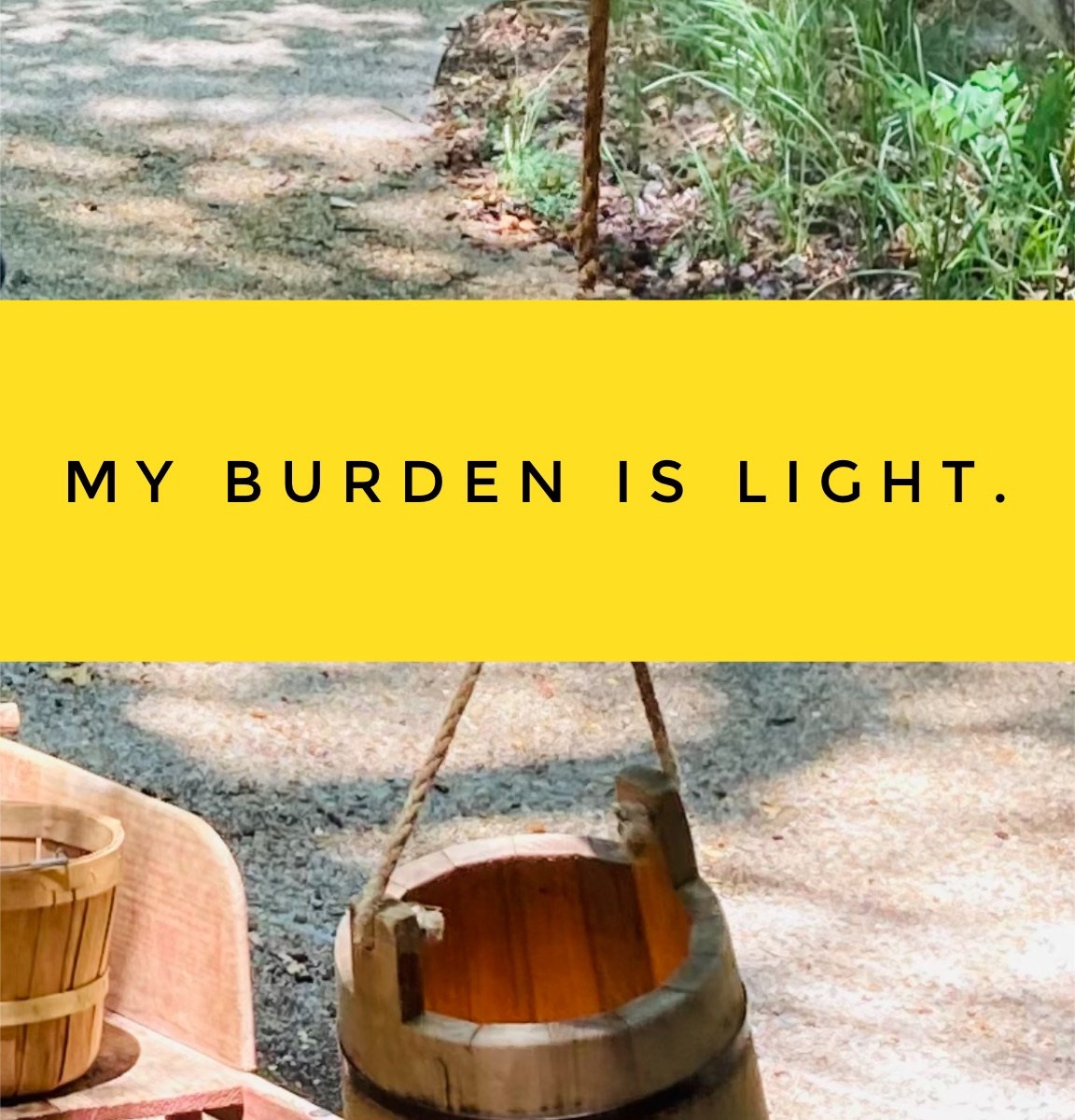
Last month, when we visited the Log Cabin Village in Ft. Worth, TX, we sawโ€” and picked upโ€” a yoke. As the woman explained how a yoke works, I had so many thoughts. I think part of the whole thought shift was the fact that I never actually thought of yokes as being something people carriedโ€” I always thought of them as something oxen were strapped with. But as I saw my husband lifting the yoke up and over his shoulders, the woman explained how carrying buckets of water was really hard on not just the arms, but the hands. The muscles would get tired, and the rough rope would dig into the palms and fingers, making it painful to carry water for long.

And it dawned on meโ€” that the yoke doesnโ€™t actually take the burden away, or make it โ€œlighterโ€ in pounds. But when the burden is wrapped around a yokeโ€” the yoke shoulders the brunt of it. It makes carrying the same amount of water much easier. It saves the weaker joints and the muscles and skin from the extreme exhaustion of the task.

Another thing about the burden of carrying water is that it wasnโ€™t optionalโ€” water was something that HAD to be found and transported. The burden wasnโ€™t optional. Water was life, and finding it and taking it back to people and animals and plants HAD to happen.

Isnโ€™t that the truth about life? There are burdens that we simply must carry. Daily. As much as we would want to skip a day or a week or even all of our livesโ€” we canโ€™t. The burden must be borne.

If our burden must be carried, why? Why do we insist on having it dig deep, in a way God didnโ€™t design for us? Jesus is offering a wayโ€” the Wayโ€” to make our burdens easier to bear. The burden might remain, even in the same amount.

But with Jesus, we can rest.

He bears the brunt. He takes on our weight for us and in the doing, saves us from the acute, painful task of trying to do it all alone. ๐Ÿ’›

embarrassment, empathy, endurance: why the show must go on… and why we should help it

Once, several years agoโ€”ย before marriage and babiesโ€”ย I found myself giving a 50 minute long one-woman show to an auditorium with over 500 people watching me. ย As if that wasnโ€™t adrenaline-inducing enough, I had just stepped on the edge of my floor length skirt and felt the clasp in the back pull and undo.

That was fun.

I remember, continuing my performance, and simultaneously pleading for the Good Lord, in His mercy and goodness to prevent my skirt from completing its malfunction in front of everyone. ย That I could just do myย โ€œjob,โ€ย without something very important falling down around me.

Itโ€™s an extreme AND completely real example. ย It’s one that I thought wouldnโ€™t apply to me again very much at all in my life. ย But, man, was I wrong.

Here we all are, arenโ€™t we? ย Just trying to do ourย โ€œjobsโ€โ€”ย trying to live and maybe tell our stories. ย We donโ€™t want any extra drama. ย We donโ€™t want anything more to think about because the job, though hopefully enjoyable , is still daunting enough. ย But then… we feel something begin to give way that shouldnโ€™t. ย We suddenly shift into worry and doubt and fervent prayer because we know, that just a little bit moreโ€ฆย just another inchโ€ฆย just one more slight shiftโ€ฆย and we will be vulnerable in ways we never, ever want to be.

IF my skirt had actually fallen down that dayโ€ฆย if that whole auditorium had seen me, standing there, exposed in my undergarments and embarrassmentโ€ฆย honestly, what would have happened? ย Okay, so I would have been completely mortified and would have wanted to claw up the floorboards of that stage in order to disappearโ€ฆย but besides that? ย What would have happened?

I wouldnโ€™t have died, no matter how much I would have wanted to.  I would have swallowed hard, and pulled my skirt up, made some comment to attempt to save face, and feel my cheeks grow hot.  My throat might have almost closed from choking down the emotion of it allโ€ฆ and I might have even had to excuse myself before going back out and continuing where I left off.

Thatโ€™s what would have happened.  Because I needed to finish my job.  Finish what I started.  Tell the story that placed me on that stage in the first place.

I think, whether or not you have been on stage at all, you know exactly what it is like to be in the scenario I found myself.ย ย Life has taught you to be afraid that something horrible is going to derail what you are doingโ€” and what you are doing is plenty enough already, thankyouverymuch. ย We are afraid to be left exposed and scrambling. ย We are petrified of our jobs being harder, our lives more complicated. ย We are scared of contingency plans and crisis modes and being distracted from what was **so carefully** planned, practiced, and rehearsed. ย And maybe, just maybe, we are worried about what people would say and think as they witness it all fall.

Hardship is so, well, hard to even think about.  Thereโ€™s a reason why those thoughts instantly drive us to worryโ€” and hopefully and much betterโ€” prayer. The grand irony of it all is that we are just as much audience as performer.  We watch others live all around us, and donโ€™t think for one second that they are worried about their own wardrobes exposing them, or tripping on stage, or forgetting their lines.  That they are just as afraid and vulnerable to messing up themselves.  They seem to have it all together as they go along, while we feel like we just stumbling by.  Honestly, shouldnโ€™t we know better by now?

We know the truth. ย The fact that we are all actors should make us the most empathetic audience in the world. ย It is exactly because I know what it is like to imagine the worst case scenario (by almost being or ACTUALLY being in worst case scenarios) that I can lean into otherโ€™s experiences when their worst case scenario happens. ย Itโ€™s why we can join others in the uncomfortable, and not let our own awkwardness keep us from doing what is right. ย And what is right? Right is swallowing your own discomfort to make it easier for your friend or neighbor or fellow momma to pick up her skirt and her pride, swallow hard, and keep going when her world is falling apart.

Best of all, we donโ€™t have to say and think anything beyond admiration and supportโ€” in whatever capacity we can.  

Life itself is a stage, someone brilliant once said. ย 

We are all players. ย 

And in this global cast, faith, hope, and love is the obligation for all of us.

Random bits & pieces: free mulch and foraging

The weather is getting warmer, and the plants are making their way from the cups and little planters we started seeds in to our raised beds. Maybe Iโ€™m just getting old or maybe what excites me in my life has changedโ€” probably both ๐Ÿ˜‚โ€” but gracious, I delight in seeing seedlings grow. Just little green bursts of friendly potential.

Watching my kiddos take pride in the plants is just another added privilege to see.

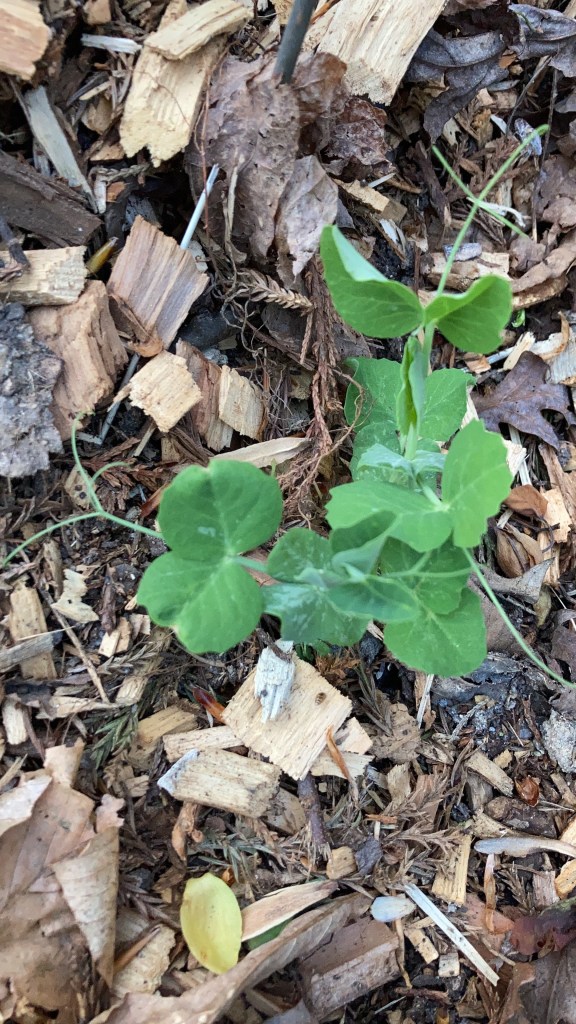
Behold, my buddyโ€™s pea plant. ๐Ÿ™‚

If you look at the picture above, youโ€™ll see some mulch around the peas from a pile that we received for free from a company called Chip Drop (https://getchipdrop.com/). We went to the website, filled out our info and a few days later, a truck was dumping a huge mulch mountain in our front yard! Weโ€™ve placed it on our flower beds and in our raised beds as filler and enrichment.

It was completely free and convenient, and will be doing it again in the future, Iโ€™m sure.

Another way, besides gardening, that Iโ€™m enriching my own knowledge and experience is learning how to use โ€œwildโ€ and useful plantsโ€” for food, comfort, and wellness.

See, I didnโ€™t grow up on a farm. I didnโ€™t grow up learning about plants or animals, how to observe nature not just for its beauty, awe, and intricatenessโ€ฆ but for how we can exist and be symbiotic with itโ€” how it provides for us in unexpected places, and how we, in turn, can provide for it, too.

Here is a plant I never, ever knew was edible, and it grows in our shady spaces so incredibly wellโ€ฆ hostas! Here was my first time, harvesting and cooking hosta from our yard! To my surprise, it cooks down and tastes very similarly to spinach. Iโ€™m researching other ways to use it in my cooking and mealsโ€ฆ but I was thrilled to start here!

My daughterโ€™s friend, P, was over while I was snipping the hostas and was still there as I finished cooking them and needed โ€œtaste-testers.โ€ Three out of four kids lined up, and they each loved them! Later that day, I got a text from Pโ€™s mom, asking me about my โ€œhosta recipe.โ€

And I laughed because not once ever in my life did I ever think I would have a hosta recipe, let along be asked for it.

Hereโ€™s to tasting food from our gardens and yards and learning about how to care for them well while learning how they can care for us.

If thatโ€™s not essential living, I donโ€™t know what is. ๐Ÿ’›

the right instructions.

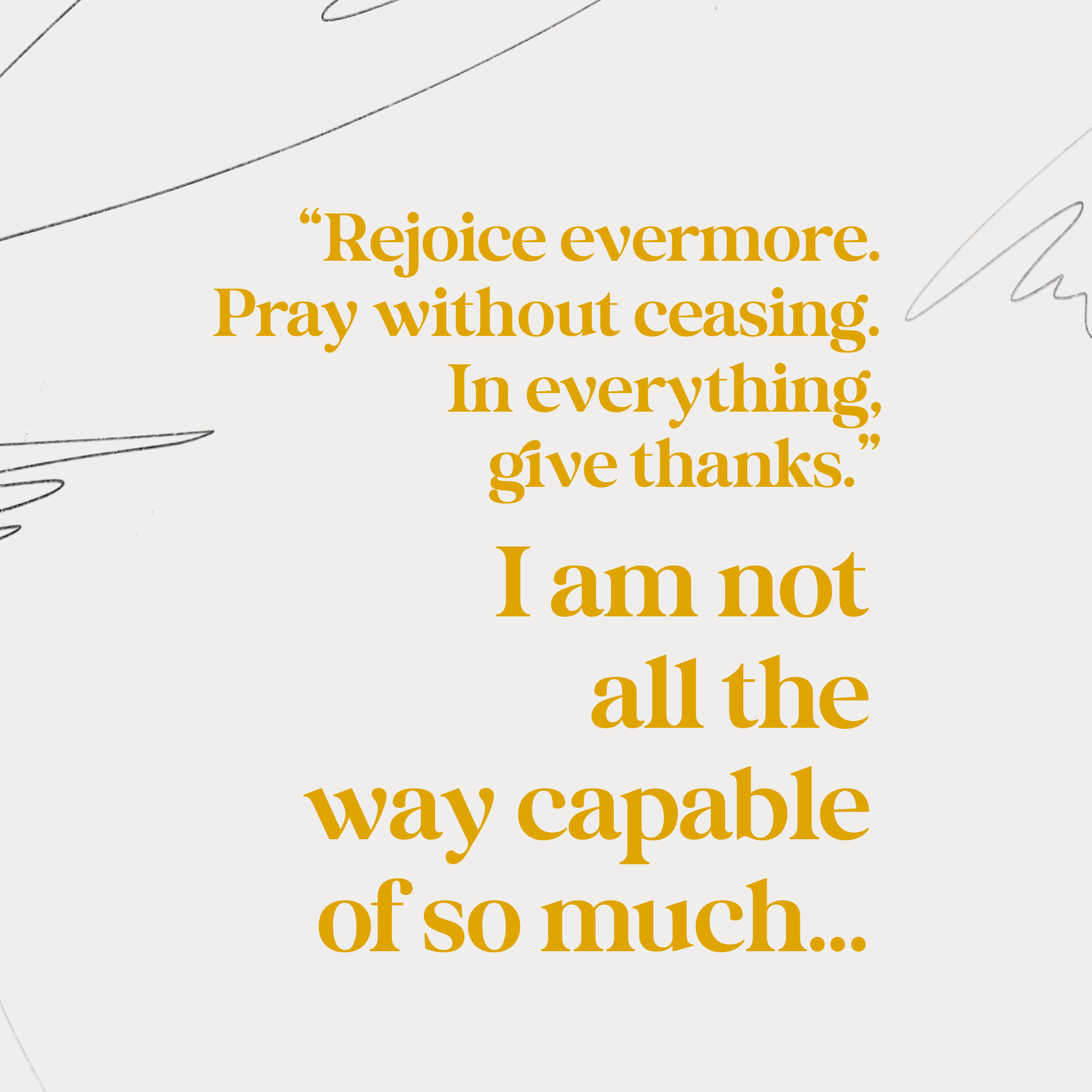
Wendell Berry once said, “You mustn’t wish for another life. You mustn’t want to be somebody else. What you must do is this: ‘Rejoice evermore. Pray without ceasing. In everything give thanks.’ I am not all the way capable of so much. But those are the right instructions.”

I don’t know about you, but there are some days that I just love where Iโ€™m at and what Iโ€™m doing. The moments seem light and joyful, and I feel perfectly placed in my life.

And there are days I donโ€™t.

I can blame it on a lot of things: the news. My lists. The worries on my shoulders. Grief. Extra fighting from the kids. Exchanged sarcasm. The toddler climbing into bed because a storm ignited her fearsโ€ฆ making us all restless. And squished. And sleep deprived.

But the fact of the matter is: the biggest hinderance to my own happiness is my disconnect to the command to give thanks.

You know the verse, โ€œI can do all things through Christ who gives me strength.โ€ We just like to slap those words on anything tricky that we need some extra diligence forโ€ฆ but what, specifically, is it referring to? Paul is referring to being contentโ€” in every circumstance. He says that he has learned to do it, no matter what. How? He can do it โ€œthrough Christ,โ€ who gave him strength *to give this thanks.*

What do you need to give thanks for? What gives your heart pause, just thinking about hoisting it to heaven with gratitude on your lips? I can think of a few things that I feel are just too hard, too sad, too hurtful for me to be thankful forโ€ฆ but fortunately, we donโ€™t have to do it alone. We have a Helper to lift our offering high, and intercede with perfect words we have an impossible time finding.

Christ.

He will give us strength.

Strength enough to offer gratitudeโ€ฆ

and in the doing, we are placed in the perfect position to receive His grace.

And isnโ€™t that something we can be oh so thankful for? ๐Ÿ’›

embracing grace in the grind.

For those of you who grow weary in well-doing sometimes– or easily get overwhelmed with the task of doing tasks without seeing the list grow smaller… this is a reminder:

It’s okay to let things go sometimes.

If there are certain things that you can’t *stand* being messy– as in, it wears on your mental or physical well-being– then by all means, keep doing those things. But others? It might just be okay to give themโ€ฆ space.

This quotation by Emily P. Freeman is talking about spiritual practices, but I’m going to apply it to the here and nowโ€ฆ

“Itโ€™s not about what items on a [cleaning] checklist that we need to check off. In fact, if a [task] is causing you to experience shame, anxiety, tension, or overwhelm, Iโ€™d say thatโ€™s a practice you donโ€™t need to be doing right now. It doesnโ€™t mean the practice itself is bad or that youโ€™ll never engage with it again, but anxiety in a practice is your body trying to tell you something. It could be an arrow to a wound. It may also be, and often is evidence of a season of growth or change, even though it probably doesnโ€™t feel that way, but that could be what it isโ€ฆ

There is a true narrative and that is the stunning and relentless love God has for you. If a practice runs counter to that narrative, take a pause, take a break, take a breath and find a practice that reminds you of the love of God instead.”

For me, this means I can’t ignore my kitchen forever (nor do I want to)… but it does mean that it is better for me to ignore it until my soul is restored and I can clean it in a healthier space, instead of one of shame (“if you don’t clean this right away, you are lazy”) or anxiety (“I don’t want it to be a mess in case someone stops by”) or overwhelm (when I look around and let simple kitchen clutter upset me in ways that it shouldn’t). THAT is a sign: if the kitchen overwhelms me, that is because I am already overwhelmed, and I need to sit and deal with that before the dishes.

It’s hard for me to do… but I feel like it will lead to a much happier, healthier me, and actually give me the capacity to love my home better overall. โค๏ธ


If you are looking for a place to get ideas about how to love your home while still embracing grace in the grind, please head over to the FB group, Gathering Wellness. We choose a new topic each month to explore and right now we are in the middle of encouragement, conversations, etc., that are all about making our home a loving place for everyone to thrive in. ๐Ÿ™‚

examening your home

I was listening to a podcast the other day, and it was talking about the Daily Examen– what’s typically considered a spiritual practice of reflection by asking & answering a pattern of questions at the end of the day.

As I was listening, my thoughts connected that idea to my goal for the month of February– loving my home and making it easier for my family and I to love being in it. I’ll be honest; I am so thankful for my home… but the daily-ness of all the daily tasks that are also housed here overwhelm me at times. I like to do things and then move on the next thing and for projects to be “done…” but there’s nothing done about the bits of food that reemerge on the floor, or the dishes that reappear in the sink, or the laundry that regrows in our hampers. And sometimes, those things make me feel like I can’t actually do what I WANT to do in my home and with the people in it.

So this month, I’m reshaping my thoughts around my home, and finding better tools for me to love it better.

As I listened to the 5 steps of the Examen, my mind tweaked the points a bit… and I wanted to share them. You know, just in case someone else needs to regroup and offer a reminder of a bigger, lovelier picture.

1) Think back to your day and find the love that you had while at home. Was it something specific about a space? An item? A moment you had there? The people in it? Find a moment at home that brought you joy, for whatever reason.

2) Show gratitude for that moment. Offer thanks for it.

3) Allow yourself to feel whatever feelings arise after that. It “makes sense” that offering thanks would/”should” bring a positive emotion, but that might not always be the case. I can be thankful for a moment, and still feel a shadow that someone or something wasn’t in it. That’s okay to feel and to acknowledge.

4) Take that moment and pray from it, journal about it, process it.

5) Look ahead towards tomorrow. That might mean just having hope that tomorrow can offer the same experience… or it might mean making a mental action step about how to encourage the same type of moment. (For instance, if you realized that your morning was super peaceful because of waking up to clean surfaces and no dishes, maybe resolve to do that more often. No guilt or commitment attached– just an observation and maybe a thought to try it again.)

Anyhoo, taking time to think big picture and reflecting is huge for me– especially when I sometimes tend to make lists that feel too large and daunting OR even make it a measurement of my worth. Here’s to noting the love for and in our homes, offering gratitude for it, and believing that we can have more of it in our moments. โค