the only way out is through: Image Bearing, education, and the true cost of AI

I am passionate about teaching.

My dad was a teacher for decades, off and on, throughout my childhood and teens.

I have blinked and— somehow— I am now well into two decades of teaching myself.

(I’m still working out how, exactly, that happened.)

I want to be transparent about what this post actually is. It is not a polished position paper. It is not a formal research summary. It is something more like what happens when my brain has been carrying a growing weight of concern for long enough that it just needs to become words on a page.

These thoughts have been living in me for a while now— surfacing in quiet moments of lesson prep, interactions with students, in conversations with other educators, in the way I watch my own children move through their days. I have turned them over and over, tested them against what I see in my classrooms and what I feel at my own kitchen table.

And I finally decided the best thing to do with all of it is to just write it down.

This concern.

This bit of a sinking feeling when it comes to education and educating.

This shaping of conversations with both my students and my children when they look at the world around them and wonder where they will fit in it.

The world is changing so fast, I’m just not quite sure what to say.

(And friend, that is not something I say lightly. I tend to always have something to say. Ask anyone who knows me.)

Here’s the thing, though: I am not “just” a teacher sitting here writing this.

I am also a parent sitting exactly where you are sitting— looking at my own kids and feeling the same overwhelm of love mingling with uncertainty. (I’m sure you are not a stranger to this particular mixture of emotion…)

My children are walking into this same future. That’s not an abstraction for me.

It’s my daughters. It’s my son.

Which means everything I’m about to say, I feel with my whole self— not just as an educator, but as a mother who is wondering on how to make the same bets on the same uncertain future that you are.

We are standing at a genuinely strange moment in history. The future our kids are walking toward looks different from anything we were prepared for— and I think most of us feel that, even when we’re not quite sure what to do with the feeling.

The advice we were given? The path that seemed reliable?

Do good in school. Get a degree. Get a good thinking job.

That map seems like it will no longer be accurate.

As the adults in these children’s lives, we owe them something better than outdated directions.

Here’s what I am coming to believe, from years in this work and now watching my own children grow: the skills that will matter most in what’s coming are the same ones that have always made humans most fully human.

Beyond that, they showcase who we are as Image Bearers.

The ability…

To listen so carefully that you hear what the other person couldn’t quite say. Or what is actually being said under and around words. To know what you believe and why… and communicate it well. To tell a story that moves people and connects them to The Story.

These aren’t extras.

They aren’t enrichment.

They are the foundation.

It’s one of the main reasons I teach what I do.

I teach speech and debate because when a person learns to debate, something happens that goes far beyond learning to argue. They learn that ideas have real weight and real consequences. They learn to examine a claim— really examine it— and ask:

Is this actually true?

Is this something we should believe and do?

What happens if we take this idea and follow it all the way through?

They learn to disagree with someone respectfully— which means they first have to genuinely understand what that person actually believes and why. (This is harder than it sounds. Trust me. Actually, you probably have an idea of how hard that is.)

In a world increasingly flooded with generated content, recycled talking points, and information that sounds authoritative (whether it is or not)— the capacity to actually process those questions is not just nice to have.

It is survival skill.

I want your children and my children to be the ones in the room who can say wait— and mean it.

Who can slow things down to ask the right questions.

It only comes from practice. It comes from wrestling with words, learning to choose the right ones, and being vulnerable enough to share ideas in front of others, face-to-face. (Not screen-to-screen. But that’s another blog post for another day.)

It comes from having argued and won.

It comes from having argued and lost— and having to sit with why.

It is hard work, this friction with ideas and words and identity.

But it is good work.

It is crucial work.

Moving on from speech and debate is something I am even more passionate about…

Story.

Think about every culture that has ever existed on this earth. What do they all have in common? Not language. Not geography. Not customs or clothes.

Story.

Every single one of them.

Story isn’t just something we tell. It is something that tells us. It shapes the way we understand who we are, where we came from, what we owe each other, and what we are reaching toward. The stories a culture passes down are not just entertainment or history— they are formation. They are the invisible architecture of a people.

And the stories we tell ourselves? Quietly, in the small hours? Those are forming us too, whether we know it or not.

This is why it matters so deeply what stories our children are given— and what stories they are learning to tell. Because a child who can shape a story is a child who is learning to share meaning, not just consume it. They are learning that the world is not just a series of things that happen to them— but something they have a voice in. Something they can bear witness to. Something they can have a hand in. Something they can pass on.

Here is the thing I keep coming back to: we were made by a God who is, at His very core, a Storyteller. The whole of Scripture is not a rulebook or a list. It’s not a theology “textbook”— it is a story. With a beginning and a crisis and a turning point and a redemption and a promised ending that is better than anything we can imagine. When we teach our children to tell true stories— to tell The True Story— we aren’t just telling them to find the words, to shape plot, to speak with honesty and intention— we are not just teaching a skill.

We are echoing the One who started our Story when He spoke the first words into the dark.

And called it good.

A child who knows how to tell their own story knows who they are. And a child who knows who they are is far harder to manipulate, mislead, or simply sweep along by whatever current is moving fastest.

There is a practice I use in my home and in my classrooms that is over a hundred years old— and I am convinced it is one of the most radical things we can do for children right now.

Charlotte Mason called it narration: the simple, demanding act of closing the book and telling back what you just took in, in your own words, from your own mind. No prompts. No multiple choice. No algorithm to autocomplete your thought.

Just you, and what you actually understood, and the work of making it yours.

It sounds simple.

It is not easy.

And that difficulty is precisely the point.

Narration forces a child to own their thinking— to reach for their own language, to discover what they actually grasped and what slipped past them. In a world where any text can be instantly summarized by a machine, teaching children to summarize from the inside out is not a nostalgic, 1800s-based skill.

Today, it is resistance.

When I sit across from my own children and watch them find words for what they’re thinking and feeling, it takes more time and effort than slipping them a worksheet. But I do it because the ability to articulate your inner life— to name what you think and why, to say it out loud and own it— is one of the most protective things for both ideas and identity a person can have.

I believe that with everything in me.

Now, another thing to consider. It isn’t a new idea.

In fact, you are probably very familiar with it.

We humans gravitate toward the path of least resistance.

There has always been a version of this struggle in education— students who want the grade without the growth, the answer without the wrestling. That has always been the part of teaching.

(Frankly, it’s the part that tears me down the most.)

But something has shifted. The ease available to students now is unprecedented. And I have watched it— I have felt it— as students simply stop reaching and working and start accepting whatever is handed to them, then hand it to me with a look as though I should be satisfied with mediocrity.

(Sidenote: I’m not speaking about every student. I have some hardworking, delightful, amazing students. I am talking about an overarching shift in caliber as a whole.)

Here is what makes it harder: it’s not just that they want it to be easy.

They expect it.

Ease has led to entitlement, and somewhere along the way, the systems meant to support education have started agreeing with those who want. I am handed standards that ask less, and ask me to assign higher grades for less work (and A, B, C, etc. are NOT what they used to be). There is a quiet but unmistakable message that rigor itself is somehow unkind.

I am being asked to lower the bar at the exact moment in history when raising it has never mattered more.

I want to pause here and be clear about something, because I think it matters:

I am not advocating for raising the bar past what is developmentally appropriate. There is already a strange tendency in education to push harder in all the wrong directions— rushing literacy into four-year-olds who need to be playing, drilling academics into children whose brains are simply not yet built for that kind of abstraction.

That is not rigor.

That is anxiety dressed up as standards.

What I am talking about is something different entirely— the friction that belongs to each stage. The age-appropriate struggle that actually builds something. And about how we are systematically removing that struggle the moment technology offers an easier path.

It produces a deeply strange result. We expect kindergartners to read fluently and third graders to perform on standardized tests… but somehow, by college, students cannot construct an outline without assistance.

We accelerated the wrong things and smoothed away the right ones.

The friction we are so eager to eliminate is not the enemy of learning.

In most cases, it is the learning.

I am finding myself becoming more rigid— not because I want to be stubborn— but because I know what is being given up when the students do not.

I refuse to believe this is what learning has to become.

The exhaustion I carry isn’t from the work. It’s from loving students enough to grieve what they’re losing while they’re becoming too ignorant and too comfortable to notice it’s gone.

I am not afraid of artificial intelligence as a tool. Used wisely, it’s remarkable. But I am genuinely concerned about what happens to a generation of children who grow up using it before they’ve built the skills to know how to use it well.

Here is the risk I want to name clearly: AI doesn’t just threaten jobs. Used without wisdom, it quietly erodes the very capacities we need in order to think at all. If your child never learns to construct an argument from scratch, they won’t recognize when an AI-generated argument is wrong, or manipulative, or missing something essential. If they never struggle to find their own words, they lose the ability to notice when someone else’s words are shaping them toward a conclusion they didn’t choose and don’t want.

There is a version of the future where AI thinks for an entire generation, and that generation simply accepts it.

Not because they aren’t intelligent.

But because they never built the muscles to do otherwise.

The friction of real thinking feels unnecessary when something smooth and fluent is available on demand.

(And honestly? I think about this when I watch my own children reach for easy answers. It makes me more committed to this work, not less.)

Communication, debate, and storytelling are how we build those muscles. They are what grows discernment— so they can show discernment.

So they can share discernment.

I believe something that puts me in a somewhat unique position to speak on all of this is the fact that I don’t just homeschool my kids or teach one age group. I have my toes in all of it. I teach elementary children, junior high students, high schoolers, and college students outside my home. I see the arc— all of it— and what disconcerts me more than anything right now is that I am watching the same pattern at every single level.

The expectation of ease doesn’t arrive in college.

It is already fully formed long before then.

It is being shaped early, normalized young— and by the time students reach higher education, the idea that learning should require genuine struggle feels foreign to them. Or worse: offensive.

I’m concerned this isn’t a phase or a generational quirk.

It is systemic.

It is accelerating.

And it is starting earlier than it ever has before.

Which tells me the place to address it is not college.

It isn’t even high school.

It is now— before the expectation of effortlessness calcifies into something we can no longer reach through.

So here is my encouragement to you as parents:

Hold the line on appropriate rigor.

Keep expecting real work from your children— even when they push back, even when it causes friction, even when letting it go would be so much easier. I know that temptation intimately. I live it in my own home, with my own kids.

It is hard to be the source of the friction. It is hard to watch your child struggle and not rescue them. I know. I know.

But that struggle is not a sign that something is wrong.

It is the sound of a mind being built.

It starts with learning to speak in front of people when it’s terrifying. It starts with defending a position and discovering what you actually believe. It starts with writing a story and finding out you have something worth saying.

The people who will shape what comes next are not the ones who use AI the most. They are the ones who think rigorously enough, know themselves clearly enough, and communicate compellingly enough to direct it— and know when to push back against it.

The only way to get those skills is to be uncomfortable enough to acquire them.

I will be honest with you— I wonder, often, if I’m preparing my own kids well enough for a world I can’t fully predict.

Teaching these skills (and trusting my God!) is my answer to that fear. It’s the most honest and hopeful thing I know how to do.

The goal has never been to produce children who can compete with machines. It has always been to form people who are fully human— curious, discerning, grounded, and capable of genuine connection. People who bring something to the room that no algorithm can replicate.

Because they are what AI can never be.

Image Bearers.

We were made in the image of a God who spoke the world into being. Who told stories. Who revealed Himself through burning bushes and parables and the arc of an entire human history. Who reasons with us, invites us to come and argue, asks us to give account for what we believe and why.

To communicate, to tell truth in creative ways, to wrestle honestly with ideas— these are not merely academic skills.

They are acts of image bearing.

When a child stands up and finds words for what they believe, they are doing something that reflects the nature of the One who made them. When they learn to listen and reason and persuade with integrity rather than manipulation, they are practicing what it looks like to bear that Image with dignity.

This is why I cannot be indifferent to a generation that outsources its thinking and abandons its voice. It is not just an educational loss.

It is a human loss.

We are cultivating something sacred when we teach children to speak well, argue honestly, and tell stories that are True— and we diminish that sacredness when we let them believe that a machine can do it for them.

The goal was never just to produce good students.

It was always to form whole people, fully alive to who they are, Whose they are, and why it all matters.

That hard work has never mattered more to me than it does right now.

And it is the greatest privilege of my life to do it alongside you with this generation we are raising.

As an educator.

And as a mom.

breaking the silence.

As the Old English proverbs goes, “We never know the worth of water till the well is dry.” Layman’s terms? You don’t know what you have until it is gone.

Possessions?

We all have lost them.

Opportunities?

People?

We’ve all lost those, too.

I don’t think people think of the losing of themselves.

But here I am, over a year after my mom’s passing, months after my dad’s strokes, realizing that somewhere in the avalanche of grief and survival mode, I lost something pretty precious (to anyone, but maybe more to someone who has degrees and a livelihood in what I do…)

I lost my words.

Not all of them, of course. I still had the necessary ones—the “good morning” to my children, the lesson plans for my students, the “how was your day?” that keeps a household running. But the other words? The witty ones that used to flow from my fingertips onto pages… the more introspective ones that helped me make sense of the world? Those went silent.

It’s strange how grief doesn’t just take what’s obvious.

It reaches into the corners of who you are and quietly pockets pieces you didn’t even know were connected to what– to who– you lost.

I haven’t written here in longer than I care to admit. (A fast scroll to the date of the previous post tells you that.) It would be nice to say that I tried to open a post to write, and the blank page would just stare back at me, and the cursor would blink– ever patient and persistent– and I would just sit here and try to squeeze words out like water from a stone.

But that’s not what would happen.

I didn’t even open to write a post.

Not until this morning.

I didn’t even try.

I did try in my personal journal. But the topics bounced around the obvious. I could casually write about my day, or what the kids did. This, that, and the other.

The irony wasn’t lost on me. Everyone kept saying I should journal through my feelings, that writing would help me process the grief, especially my friends who have walked similar paths. I went to a program called GriefShare, which also praised the virtues of writing as a healing exercise. Articles online and social media all say the same thing: “Write it out. Put pen to paper. Let the words heal you.”

Me?

Proverbial Crickets.

It’s a good thing God doesn’t need my words, because He wasn’t immune to the silence, either. To be honest, I’ve always struggled with prayer a bit. I want to be a woman of prayer. More than that, I guess I want to be a woman that accepts the answers to prayer with faith, not faltering. It is a hard thing to pray hard for things– miracles and mundane alike– and just get No’s. Or Waits with an undetermined timeline. Especially when other prayers from other people seem to get the replies you pray and wish for. He’s all of our Good Father; and it is His prerogative to do as He wills. I just wish I had (have) a stronger faith to immediately take the His No’s, no questions asked, and still feel just as loved and cherished as the children that He says yes to. It’s was a Struggle. It still is.

So I borrowed words. I let David carry my complaints in his psalms. I found myself in Job’s questions. Habakkuk’s wrestling became my own—asking for answers from heaven while simultaneously declaring trust, even when you look around see emptiness where fulness used to be.

On Sunday mornings, I borrow the words straight from the worship music. I lift my voice, often wobbly. I lift my face, often wet with tears as I sing. Meanwhile, my brain is busy– stacking circumstances like pieces of evidence, crafting careful arguments against every word my mouth shapes:

“All my life you have been faithful…”

Mom’s empty chair.

“All my life you have been so, so good…”

Dad’s strokes.

“With every breath that I am able…”

Bed-bound. Slurred speech.

“I will sing of the goodness of God.”

The way what used-to-be-fun Thursdays now felt like a mountain to climb.

But I sing anyway.

Because faith isn’t by sight.

Because someday it will be.

Because truth isn’t determined by how I feel on any given Thursday.

Because sometimes the most honest thing you can do is let ancient words carry what your own voice cannot, trusting that the God who inspired them understands the difference between your doubt and your disbelief.

So I kept to the main things. I maintained my home as much as possible—though “maintained” is generous. (Ignore some doom piles and dust bunnies, please.) I poured myself into homeschooling my children, determined that their education wouldn’t suffer because their mom was drowning in sadness. I showed up for my students, crafting lessons and grading papers, channeling what felt like the last reserves of my professional self into being the teacher that I wanted to be, and that they deserved.

Honestly, some days, even these “main things” felt (feels?) like too much.

Some mornings, getting dressed felt like a monumental achievement and the simple act of making breakfast required more emotional energy than I thought I had. But I did them anyway.

I’ve learned keeping going isn’t grand gestures.

It’s stubborn insistence on putting one foot in front of the other.

Grief is like living in a fog—not the romantic, misty kind you see in movies, but the thick, disorienting kind that makes you wonder if you are going to trip at every step.

I’d find myself standing in my kitchen, completely forgetting why I’d walked in there.

I’d start sentences and lose them halfway through.

(I still do.)

But I have noticed some words are trickling back slowly, tentatively. A bit like birds that come back after being scared away. They’re different now—maybe quieter, maybe more timid. This post itself is proof of that; these sentences that fought their way out despite everything. Maybe, just maybe, they were singing “a tune without the words.” Maybe they “never stopped at all.”

To anyone else who’s lost pieces of themselves in the wreckage of loss—whether it’s your words, your joy, your sense of purpose, or something else entirely—I want you to know that those pieces aren’t gone forever.

Maybe they are just rearranging themselves, learning how to exist, to come back to a world that’s been fundamentally changed.

Be patient with them.

Be patient with yourself.

Be patient with your faith– the fumbling, the clinging–

Be patient with Frowning Providence, when He hides.

Be patient.

We’ll see the Smiling Face.

jam thumbprint cookies: a 5-ingredient (valentine) treat

My mother-in-law grows her own raspberry bushes. Rows and rows of them.

The kids love going to Wisconsin in the summer and just walking out there and stuffing their faces with these brilliantly red sweet snacks anytime they want.

The fruit is so abundant, Mom makes pies and cakes and jam galore… and then sends us back south, coolers packed with ice and her famous freezer jam. Throughout the year, we pull out a jar at a time for bread and sandwiches and even ice cream topping here and there. It’s divine.

The other day, I saw a picture of some beautiful raspberry thumbprint cookies, and knew that that our jam would have yet another application. I used this recipe as a base, but did make some tweaks, and will use them here. 🙂

We made a batch of these cookies for our poetry tea time, and the kids loved making them… and eating them. Because they were so very cute and festive, they will definitely be a part of our Valentine’s week coming up. ❤

raspberry jam thumbprint cookies

Ingredients
4 oz soften cream cheese
1/2 cup butter (room temp)
1/2 cup sugar + 2 Tbs
1/2 cup flour + 2 Tbs (all purpose)
jam (to fill the thumbprints)

Steps
1) Blend the cream cheese and butter together well. (As in fully incorporated.)
2) Mix in the sugar.
3) Mix in the flour, a “sprinkle” at a time. (The dough is going to be dense and not like “regular cookie dough.”
4) Wrap in plastic wrap and refrigerate for 30 minutes or longer. (We were impatient and waited 30 minutes.)
5) Put parchment paper or a silicon sheet on a baking sheet before making cookies. (We use something similar to these.)
6) Take tablespoons of dough and roll them into little balls before placing them on the sheet. The won’t really rise/spread, so you don’t have to worry about spacing much.
7) Once the cookie balls are placed on the sheet, press your thumb in them to make a “pool.” Don’t go all the way to the bottom. 🙂
8) Use a spoon to place some jam of choice into the divots in the cookies.
9) Preheat the oven to 350*. While the oven preheats, place the cookies in the fridge.
10) Once oven is preheated, take the cookies out of the fridge and into the oven, baking them for 10-12 minutes, until they are gold around the edges. When you take them out, they will still be soft, but they will harden as they cool.

They are simple, taste amazing, and look impressive. Create this colorful cookie (with or without the kiddos!) and enjoy.

a liturgy of preparation for a meal

I don’t know about you, but sometimes… I grow weary in well-doing. I’ve realized it isn’t actually the doing… it’s the reception of it. I feel like my work is worth something when it is received with gratitude and appreciation; but when my meals are met with whines or disenchantment, I mourn. And even get disgruntled deep down, because I feel like all of my good motivations and hard work— and good food— are just wasted.

Maybe that’s why this liturgy, found in Every Moment Holy, resonates so deeply. (The audio for this clip is not the whole thing, merely the beginning thoughts.) See, I need this prayer and reminder: that my meal planning and prep, my cooking and baking, my placing it on the table before my family is not just an act of service to them— but an act of worship to God.

And whereas one can argue that my children still need to work on thankfulness and the expression of it (they do 😂), I don’t need their approval of the main course or veggie side. It was and is worship— and God sees my work, even though He doesn’t need my meal to stave off His own hunger.

He takes and sees my offering.

And as the days pass, and I pray and cook, I have every hope that I am “an agent of a deep eternity, whose prepared meals might feed more than the body, nourishing also the hearts and hopes of those sometimes-weary souls who are well-served” by my labors.

Amen. 💛

the yoke is easy.

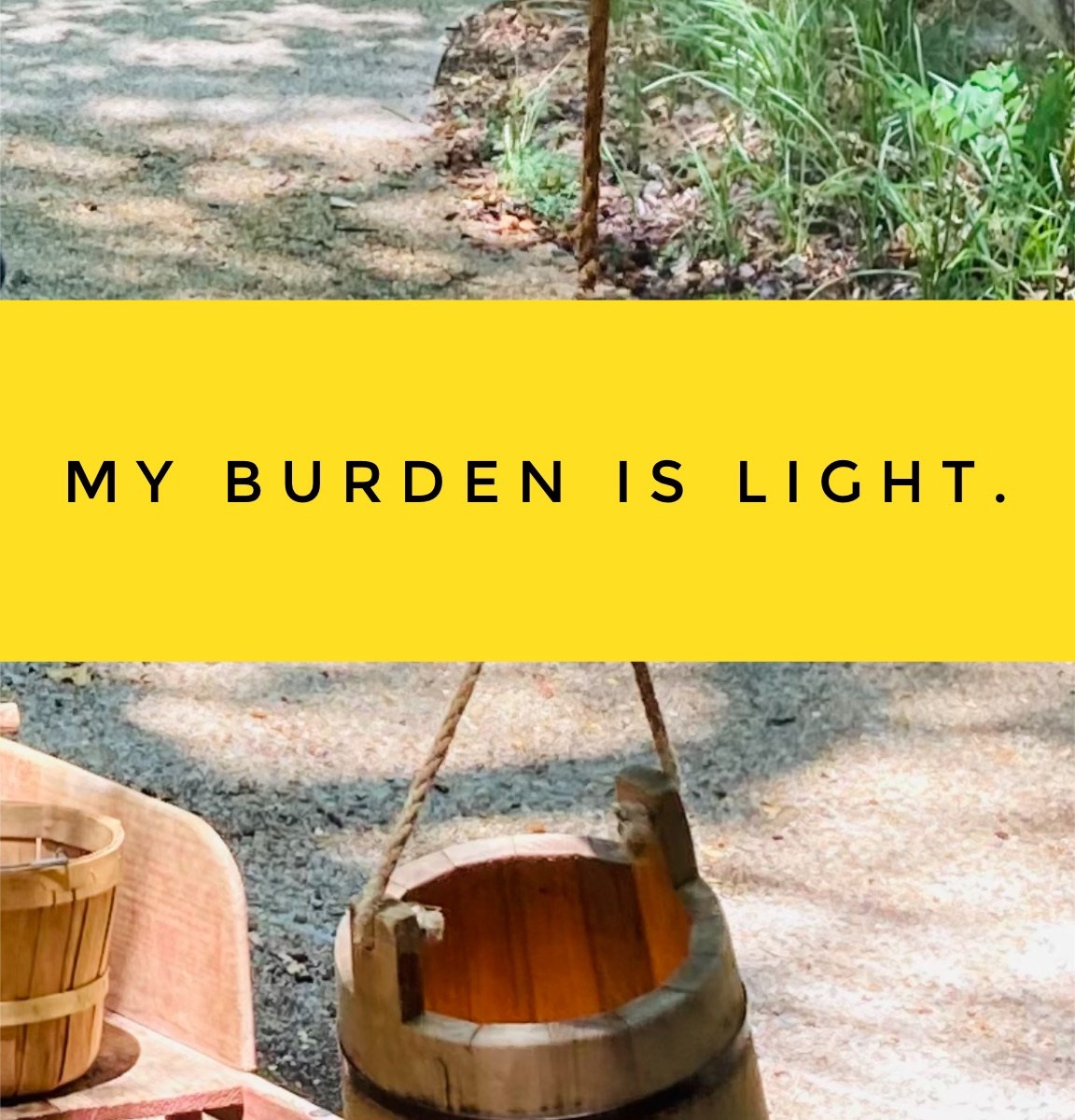
Last month, when we visited the Log Cabin Village in Ft. Worth, TX, we saw— and picked up— a yoke. As the woman explained how a yoke works, I had so many thoughts. I think part of the whole thought shift was the fact that I never actually thought of yokes as being something people carried— I always thought of them as something oxen were strapped with. But as I saw my husband lifting the yoke up and over his shoulders, the woman explained how carrying buckets of water was really hard on not just the arms, but the hands. The muscles would get tired, and the rough rope would dig into the palms and fingers, making it painful to carry water for long.

And it dawned on me— that the yoke doesn’t actually take the burden away, or make it “lighter” in pounds. But when the burden is wrapped around a yoke— the yoke shoulders the brunt of it. It makes carrying the same amount of water much easier. It saves the weaker joints and the muscles and skin from the extreme exhaustion of the task.

Another thing about the burden of carrying water is that it wasn’t optional— water was something that HAD to be found and transported. The burden wasn’t optional. Water was life, and finding it and taking it back to people and animals and plants HAD to happen.

Isn’t that the truth about life? There are burdens that we simply must carry. Daily. As much as we would want to skip a day or a week or even all of our lives— we can’t. The burden must be borne.

If our burden must be carried, why? Why do we insist on having it dig deep, in a way God didn’t design for us? Jesus is offering a way— the Way— to make our burdens easier to bear. The burden might remain, even in the same amount.

But with Jesus, we can rest.

He bears the brunt. He takes on our weight for us and in the doing, saves us from the acute, painful task of trying to do it all alone. 💛

easier than you think: soup from scratch

One of my goals this year in a part of living more simply is just to learn how to do the “convenience” foods easily with the foods that I already have on hand… instead of feeling like I need a bunch of ingredients to get dinner on the table.

A small way I’m doing that is by relying less on “staples” like canned soup, especially of the “creamed” variety.

If I have to be honest, we haven’t used a lot of a creamed of anything soups for a while, because of the additives and extras that I’m not a fan of. For instance, to make homemade cream of mushroom soup, you need 4 ingredients, up to six if you want actual cream in it and add salt.

Let’s look at the ingredients of what is in one of the most popular versions of mushroom soup. I copied and pasted directly from their website.

WATER, MUSHROOMS, VEGETABLE OIL (CORN, CANOLA AND/OR SOYBEAN), CREAM, MODIFIED CORNSTARCH, WHEAT FLOUR, SALT, MODIFIED MILK INGREDIENTS, SOY PROTEIN ISOLATE, MONOSODIUM GLUTAMATE, TOMATO PASTE, FLAVOUR, YEAST EXTRACT, DEHYDRATED GARLIC.

That’s a total of 14 ingredients, and that’s not counting any extra anything that sneaks in with vegetable oil, the modified milk ingredientS (plural means more than one, the last time I checked…), and also whatever is included in “flavour.”

(I’m not even going to go down the rabbit hole of what monosodium glutamate is… but it’s better known as MSG, if that helps get an idea. And some people really might be surprised to find soy in a cream of anything soup.)

So, what do you need to make your own creamed soup at home?

Easy: Butter. Flour.* Milk and/or cream. And then whatever other ingredient you want to be creamy. So, chicken for cream of chicken soup. Celery for cream of celery soup. Mushroom for mushroom.

(I’ll stop insulting your intelligence now. Ha!)

Oh, and salt and pepper, if you want to season the soup specifically vs. seasoning it with whatever you might be mixing it with.

Let’s chat steps. They are super easy.

First, melt your butter. For a medium thickness, you’ll start with 2 TBS.

If you are making a celery of mushroom soup, you’ll add it and soften it in the butter before adding salt and flour.

Once the butter is melted and your vegetables are softened…
Add the flour. For a medium thickness, you’ll add with 2 TBS.

Use a whisk to prevent lumps. Once it is incorporated…
Add 1 cup of liquid. Most of the time, it will be milk. In the case of cream of chicken, it should be half broth, half milk… and then add the cooked chicken.

Add salt as desired.

If you want the soup to be runnier or thicker, you’ll reduce or increase the amount of butter/flour at the beginning before adding the liquid. The flour and butter will be in equal amounts to each other.

How simple is that?

And can I say HOW MUCH BETTER it tastes? My 9 year old taste-tested and just asked me to make the soup for dinner all by itself.

Maybe next time, E… this batch is already claimed for a one-dish meal for dinner tonight. 😉

* For people who are gluten free, you can totally sub a gluten free flour here, but you might have to modify the amount of liquid, as gluten free flours with coconut flour are more absorbent. And I’ve even used almond flour itself as a replacement, but the texture is more “gritty” vs smooth, and obviously the fat is higher than the regular flour counterpart. It is definitely a viable substitute for those want to a much lower carb or flour-free version of the soup, though.

embarrassment, empathy, endurance: why the show must go on… and why we should help it

Once, several years ago— before marriage and babies— I found myself giving a 50 minute long one-woman show to an auditorium with over 500 people watching me.  As if that wasn’t adrenaline-inducing enough, I had just stepped on the edge of my floor length skirt and felt the clasp in the back pull and undo.

That was fun.

I remember, continuing my performance, and simultaneously pleading for the Good Lord, in His mercy and goodness to prevent my skirt from completing its malfunction in front of everyone.  That I could just do my “job,” without something very important falling down around me.

It’s an extreme AND completely real example.  It’s one that I thought wouldn’t apply to me again very much at all in my life.  But, man, was I wrong.

Here we all are, aren’t we?  Just trying to do our “jobs”— trying to live and maybe tell our stories.  We don’t want any extra drama.  We don’t want anything more to think about because the job, though hopefully enjoyable , is still daunting enough.  But then… we feel something begin to give way that shouldn’t.  We suddenly shift into worry and doubt and fervent prayer because we know, that just a little bit more… just another inch… just one more slight shift… and we will be vulnerable in ways we never, ever want to be.

IF my skirt had actually fallen down that day… if that whole auditorium had seen me, standing there, exposed in my undergarments and embarrassment… honestly, what would have happened?  Okay, so I would have been completely mortified and would have wanted to claw up the floorboards of that stage in order to disappear… but besides that?  What would have happened?

I wouldn’t have died, no matter how much I would have wanted to.  I would have swallowed hard, and pulled my skirt up, made some comment to attempt to save face, and feel my cheeks grow hot.  My throat might have almost closed from choking down the emotion of it all… and I might have even had to excuse myself before going back out and continuing where I left off.

That’s what would have happened.  Because I needed to finish my job.  Finish what I started.  Tell the story that placed me on that stage in the first place.

I think, whether or not you have been on stage at all, you know exactly what it is like to be in the scenario I found myself.  Life has taught you to be afraid that something horrible is going to derail what you are doing— and what you are doing is plenty enough already, thankyouverymuch.  We are afraid to be left exposed and scrambling.  We are petrified of our jobs being harder, our lives more complicated.  We are scared of contingency plans and crisis modes and being distracted from what was **so carefully** planned, practiced, and rehearsed.  And maybe, just maybe, we are worried about what people would say and think as they witness it all fall.

Hardship is so, well, hard to even think about.  There’s a reason why those thoughts instantly drive us to worry— and hopefully and much better— prayer. The grand irony of it all is that we are just as much audience as performer.  We watch others live all around us, and don’t think for one second that they are worried about their own wardrobes exposing them, or tripping on stage, or forgetting their lines.  That they are just as afraid and vulnerable to messing up themselves.  They seem to have it all together as they go along, while we feel like we just stumbling by.  Honestly, shouldn’t we know better by now?

We know the truth.  The fact that we are all actors should make us the most empathetic audience in the world.  It is exactly because I know what it is like to imagine the worst case scenario (by almost being or ACTUALLY being in worst case scenarios) that I can lean into other’s experiences when their worst case scenario happens.  It’s why we can join others in the uncomfortable, and not let our own awkwardness keep us from doing what is right.  And what is right? Right is swallowing your own discomfort to make it easier for your friend or neighbor or fellow momma to pick up her skirt and her pride, swallow hard, and keep going when her world is falling apart.

Best of all, we don’t have to say and think anything beyond admiration and support— in whatever capacity we can.  

Life itself is a stage, someone brilliant once said.  

We are all players.  

And in this global cast, faith, hope, and love is the obligation for all of us.

Random bits & pieces: free mulch and foraging

The weather is getting warmer, and the plants are making their way from the cups and little planters we started seeds in to our raised beds. Maybe I’m just getting old or maybe what excites me in my life has changed— probably both 😂— but gracious, I delight in seeing seedlings grow. Just little green bursts of friendly potential.

Watching my kiddos take pride in the plants is just another added privilege to see.

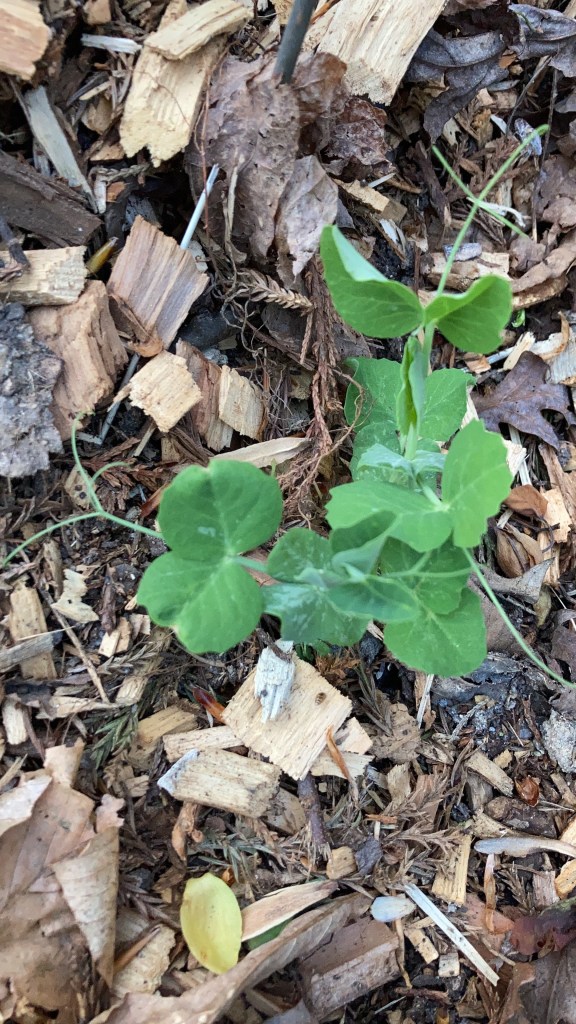
Behold, my buddy’s pea plant. 🙂

If you look at the picture above, you’ll see some mulch around the peas from a pile that we received for free from a company called Chip Drop (https://getchipdrop.com/). We went to the website, filled out our info and a few days later, a truck was dumping a huge mulch mountain in our front yard! We’ve placed it on our flower beds and in our raised beds as filler and enrichment.

It was completely free and convenient, and will be doing it again in the future, I’m sure.

Another way, besides gardening, that I’m enriching my own knowledge and experience is learning how to use “wild” and useful plants— for food, comfort, and wellness.

See, I didn’t grow up on a farm. I didn’t grow up learning about plants or animals, how to observe nature not just for its beauty, awe, and intricateness… but for how we can exist and be symbiotic with it— how it provides for us in unexpected places, and how we, in turn, can provide for it, too.

Here is a plant I never, ever knew was edible, and it grows in our shady spaces so incredibly well… hostas! Here was my first time, harvesting and cooking hosta from our yard! To my surprise, it cooks down and tastes very similarly to spinach. I’m researching other ways to use it in my cooking and meals… but I was thrilled to start here!

My daughter’s friend, P, was over while I was snipping the hostas and was still there as I finished cooking them and needed “taste-testers.” Three out of four kids lined up, and they each loved them! Later that day, I got a text from P’s mom, asking me about my “hosta recipe.”

And I laughed because not once ever in my life did I ever think I would have a hosta recipe, let along be asked for it.

Here’s to tasting food from our gardens and yards and learning about how to care for them well while learning how they can care for us.

If that’s not essential living, I don’t know what is. 💛

Companion planting… with a twist

In our Gathering Wellness group* for the month of March, we have been concentrating on how to start a garden, seed prep, planting, and plant care for the season ahead. (Gardening is one of the best ways to practice reliance and cut the gardening budget while learning life skills… so a win/win/win!) Yesterday, we chatted a bit about companion plants: how some plants are great friends… and others aren’t.

A hack that my husband and I have used before in a small capacity and really plan to use a lot more of this year is the idea of companion SPRAYS… not just plants.

We’ve used essential oil sprays on our plants before, mainly for luscious green in our home and for pest-aways on our plants (Brian has such a cool story about cedarwood and roses!)… but I’m really wanting to step it up a notch this growing season.

What’s the idea behind companion sprays?

Well, essential oils are made from plants (I feel like I should say “duh” here, ha!)… so consider using oils in place of your companion plants. Companion sprays might work especially well with smaller plots of land or are doing container gardening!

Let’s look at an example. Say you want some luscious green beans this summer, but need to plant other veggies instead of transplanting a lavender bush beside your beans. (Don’t get me wrong, though… lavender is so great to have on hand, but that’s another post!) So, grab your Lavender essential oil instead, and let it do the work for you while you save soil space.

Here’s a guide to creating Companion sprays to use on the soil and leaves of the plant: Add 10-15 drops of the corresponding essential oil to a 4 oz. glass spray bottle. Top with distilled water; shake before each use. So easy!

PLANT …………… COMPANION PLANTS

Green Beans….… Lavender, Basil

Broccoli……………. Basil, Thyme

Carrots……………… Sage

Cucumber…………. Sage

Onion……………..…. German Chamomile

Potatoes………….… Basil, Sage

Tomatoes………….. Basil


I think we are going to try a Basil spray first, since it seems to be friends with lots of types of plants!

I’ll keep you posted as the season goes on!

If you want to check out a whole little e-zine on some of the other information about how oils can be used to encourage growth and troubleshoot problems in your garden, click the button below to read more. 🙂

  • Gathering Wellness is an interactive FB community where we learn about lifeskills, homemaking, and wellness together. To join us, just click here!

the right instructions.

Wendell Berry once said, “You mustn’t wish for another life. You mustn’t want to be somebody else. What you must do is this: ‘Rejoice evermore. Pray without ceasing. In everything give thanks.’ I am not all the way capable of so much. But those are the right instructions.”

I don’t know about you, but there are some days that I just love where I’m at and what I’m doing. The moments seem light and joyful, and I feel perfectly placed in my life.

And there are days I don’t.

I can blame it on a lot of things: the news. My lists. The worries on my shoulders. Grief. Extra fighting from the kids. Exchanged sarcasm. The toddler climbing into bed because a storm ignited her fears… making us all restless. And squished. And sleep deprived.

But the fact of the matter is: the biggest hinderance to my own happiness is my disconnect to the command to give thanks.

You know the verse, “I can do all things through Christ who gives me strength.” We just like to slap those words on anything tricky that we need some extra diligence for… but what, specifically, is it referring to? Paul is referring to being content— in every circumstance. He says that he has learned to do it, no matter what. How? He can do it “through Christ,” who gave him strength *to give this thanks.*

What do you need to give thanks for? What gives your heart pause, just thinking about hoisting it to heaven with gratitude on your lips? I can think of a few things that I feel are just too hard, too sad, too hurtful for me to be thankful for… but fortunately, we don’t have to do it alone. We have a Helper to lift our offering high, and intercede with perfect words we have an impossible time finding.

Christ.

He will give us strength.

Strength enough to offer gratitude…

and in the doing, we are placed in the perfect position to receive His grace.

And isn’t that something we can be oh so thankful for? 💛