
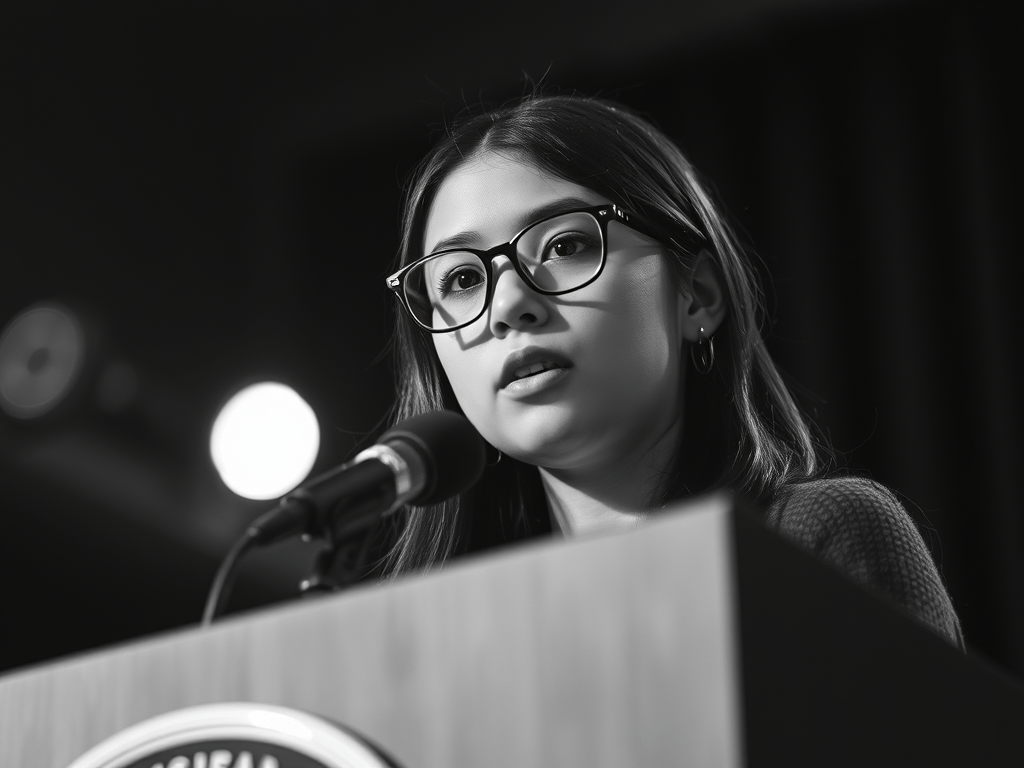
I taught debate before I ever heard of Charlotte Mason.
For years, I stood in front of students and taught them how to research, how to argue, how to listen carefully to an opponent and find the gap in their thinking.
I encouraged them as they stood behind the podium and learned to speak with conviction about something they were just beginning to understand.
It felt important.
It felt right.
(It still does.)
Then I got married. Had kids. Decided to teach them at home… and found Charlotte.
I came to her the way a lot of homeschooling moms do— looking for something that wasn’t just checking boxes. I wanted something more. Something that intertwines story, fosters curiosity, encompasses the whole person, and makes sense of how children learn.
Once I discovered her, I actually found myself having a bit of an educational identity crisis. I couldn’t instantly connect what and how I had been teaching with what I felt I should be teaching now. At least, not right away.
When people ask me whether debate is really compatible with a Charlotte Mason education— whether the formal structure, the research demands, the timed rounds and the rebuttals feel too institutional, too mechanical, too “un-Masony”— I understand. I do. I wrestled with that question myself until I realized I didn’t need to make debate fit my newly-found educational philosophy.
As I dug in deeper and looked closer, I found that Mason gave me language for what I had been doing with debate for years before I ever really knew it.
In fact, Mason’s philosophy is actually *in* what I was doing all along.
Let me allow Mason to help me show you why.
1. Charlotte advocates that you only truly know what you can tell.
That’s the whole premise of narration, isn’t it?
“A narration should be original as it comes from the child,” Mason wrote, “that is, his own mind should have acted on the matter it has received.” Not repeated. Not regurgitated. Not filled into a blank on a worksheet. Acted upon.
Owned.
When a debater builds a case, she isn’t reciting sources. She is narrating her research— deciding what matters, what the evidence actually establishes, what the other side will say, what she genuinely believes about a real problem in the real world. Her own mind has to act on what it has received.
Mason called narrating “an art, like poetry-making or painting, because it is there, in every child’s mind, waiting to be discovered” (Home Education, Vol. 1, p. 231).
My contention is that debate is where that art is tested. It is narration made accountable to an audience.
Made rigorous by opposition.
Made honest by the fact that you actually have to know what you are talking about. (Because people will call. you. out.)
And here is where the “true knowing” gets undeniable:
Consider a student who has spent an entire academic year on the current (25-26) NCFCA resolution: The United States Federal Government should significantly reform Congress. The debater doesn’t read a textbook chapter about the legislative branch and move on. She reads constitutional scholars and policy analysts. She studies the history of congressional reform, the mechanics of the filibuster, the appropriations process, the architecture of committee power. She reads arguments she disagrees with— and has to understand them well enough to take them apart.
(One could also see the depth of research this skill demands as yet another Charlotte Mason principle supported. Debate is the table. The resolution is sets it. And the debater itself, with every angle she reads and researches… spreads her own feast of ideas about the subject itself. Is that not a living, working example of there being “no education but self-education?”)
The debater discusses what she is learning in practice rounds. In constructive speeches. In cross-examinations where a quick opponent finds gaps in her thinking and forces her to fill it. On the spot.
She writes cases. Revises them. Throws them out. Writes and revises yet better ones.
She narrates— in Mason’s truest sense— dozens of times, in countless forms and ways, in front of a variety of audiences.
By the end of this year? I guarantee that debater knows more about the inner workings of Congress than most American adults. Not as a list of memorized facts. Self-educated with a living knowledge — the kind she can speak about confidently behind a podium and just as comfortably across a dinner table. This knowledge is the kind that would leave most adults quietly reaching for their phones to find a talking point or two just to engage.
And that knowledge? It’s not just her’s now… but for years to come.
The knowledge is hers because she has spoken it, defended it, refined it, and survived someone’s best effort to take it apart. It is not veneer. It is not sawdust. (More about that later.)
It is genuinely, deeply, irreversibly hers.
That is Mason’s narration at its fullest expression.
2. Charlotte advocates the discipline of habits.
That’s Mason’s seventh principle. And she wasn’t talking about rigid routines for their own sake.
She was talking about the shaping of a person.
“Every day, every hour, the parents are either passively or actively forming those habits in their children upon which, more than upon anything else, future character and conduct depend” (The Original Home School Series, p. 92).
Debate forms habits with a particular kind of intensity. The student who is learning to argue well has to develop the habit of attention to a topic, to a text, and to an opponent’s actual words. The habit of researching carefully. The habit of organizing their thoughts. The habit of choosing language purposefully. The habit of time management— in prepping the arguments and evidence before the round and how you use the time you speak inside the round itself.
She has to learn— through experience, not lecture— that a careless claim will be exposed. And that a well-reasoned one will hold. (Hopefully.)
This is not artificial structure in the way Mason feared. It doesn’t bypass the child’s mind with pre-packaged thinking.
It demands that the child’s mind do the hard work.
The structure exists not to replace thought. But to make thought rigorous.
3. Charlotte advocates that the mind feeds on ideas, not just information.
Mason’s eighth principle is maybe her most urgent one: “In saying that ‘education is a life,’ the need of intellectual and moral as well as of physical sustenance is implied. The mind feeds on ideas, and therefore children should have a generous curriculum.”
And then this, which gives me pause every time I read it:
“For the mind is capable of dealing with only one kind of food; it lives, grows and is nourished upon ideas only; mere information is to it as a meal of sawdust to the body.”
Sawdust.
That’s the indictment of so much of what passes for education right now. And honestly? It applies to a certain kind of debate training, too. A debater who speed-reads evidence she doesn’t understand, who wins rounds on technical points rather than genuine engagement— she has consumed sawdust. She has information without ideas.
But debate, learned and taught well, is one of the richest feasts I know.
Charlotte says, “Thought breeds thought; children familiar with great thoughts take as naturally to thinking for themselves as the well-nourished body takes to growing” (The Original Home School Series, p. 303). Debate done well creates an appetite for real food that carry students beyond school into life.
The topics NCFCA students research aren’t hypothetical. They connect directly to the world those students are about to step into. The depth required doesn’t allow for shortcuts. The prep work, the rounds, the sharp opponent who will find weaknesses in their thinking— none of it permits them to stay on the surface.
Mason insisted that what we offer children must not be “watered-down, broken into steps, or made easy.”
In a world where reading, writing, and research are being steadily simplified— where the friction of real learning is being engineered away (see my blog post about that here)— debate is one of the last places where a student’s knowledge is on its full, vulnerable, authentic display.
A Bit about debate Charlotte would NOT advocate.
A word of honesty, because I think it’s important. I don’t defend every form debate takes.
And I don’t think Charlotte would, either.
I referenced this style previously: the circuit-style performance that prizes speed over clarity, that rewards jargon over genuine communication, that trains students to gasp for air to increase words per minutes versus persuade a real person. That’s a different type of debate. (I’d argue whether it even is debate.) I believe Mason would have had a problem with it. She was rightly suspicious of any structure that substitutes itself for genuine thought.
“The function of education,” Mason wrote, “is not to give technical skill but to develop a person” (A Philosophy of Education, Vol. 6, p. 147).
Technical skill in service of nothing is not education.
But skill in service of truth— the ability to take what you genuinely understand and communicate it with precision and courage— that is exactly what she was after.
I know this because I was teaching it before I had her words for it.
We are not training students to win rounds.
We are training them to think. And then to speak with the confidence that genuine thinking earns.
Charlotte Mason would appreciate this.
It is narration— grown up, made public, made answerable.
It is the feast of ideas made active.
It is discipline in service of life.
When I began teaching debate the way I do so many years ago, I was teaching it in a Charlotte Mason way. I just didn’t know that’s what I was doing yet.
I was already in the room, already teaching, already believing— without the words for it— that argument was a form of knowing, that speaking well was a form of thinking, that the discipline of a good case was the discipline of a good mind.
She just handed me the language.
And sometimes that’s what a philosophy does. It doesn’t change what you’re doing.
It tells you why you were really doing it all along.

 embracing essentialism